Brand Strategy for Startups: Category Design vs. Entry
May 15, 2026





Here is a scene most brand strategy agencies for startups know well.
A founder walks in. They have a deck. It is clean, confident, and somewhere around slide four there is a competitive landscape matrix. Their brand is positioned top-right. Everyone else is bottom-left.
They want to stand out. They want to look better than the alternatives. They want a name that pops, a visual identity that signals quality, and messaging that makes their product feel like the only rational choice.
It is a good brief.
It is also the wrong brief.
Not because the founder is unsophisticated. Most of the founders I have worked with who arrive with this kind of brief are sharp, well-read, and deeply knowledgeable about their market. The problem is not intelligence. The problem is the starting position. They have accepted someone else's frame for what the category is, what the problem looks like, and how customers should decide. Everything they are asking for, from the name to the positioning, is optimised for a game they did not design.
Most brands enter categories. The ones that build lasting, compounding value design them.
That distinction is not semantic. It is not a matter of ambition or attitude. It is a structural difference in how strategy works, what kind of identity it produces, and what the commercial ceiling looks like once the market matures.
The goal of this piece is to make that distinction precise. I will lay out a comparison framework, walk through three cases where the category design move produced outcomes that category entry could not, and give you five diagnostic questions you can run against your own brief right now.
Whether you are a founder building something new or a CMO evaluating what your brand strategy agency for startups actually needs to deliver, the questions are the same. And so is the consequence of answering them wrong.
Contents
1. Why Brand Strategy for Startups Usually Gets Stuck at 'Better'
2. The Core Distinction: Category Entry vs. Category Design
3. What Category Kings Actually Do: Three Documented Cases
4. The Framework: Five Diagnostic Questions for Startup Brand Strategy
5. What This Means in Practice: How the Work Changes
6. Frequently Asked Questions
7. The Frame Is the Strategy
Why Brand Strategy for Startups Usually Gets Stuck at 'Better'

The brief that arrives at every brand strategy agency sounds something like this: 'We are like X, but better. We are faster. We are more affordable. We are built for a different kind of customer.'
It is a rational starting point. And it is a structural trap.
When you position inside someone else's category, you accept their frame for what the problem is. You accept their definition of what a solution looks like. You accept their evaluation criteria. You are, in effect, climbing someone else's ladder.
Al Ries and Jack Trout described this dynamic in Positioning: The Battle for Your Mind (1981), when they introduced the mental ladder metaphor. Customers organise brands hierarchically in their minds. The top rung is hardest to displace, not because the leader is necessarily better, but because the frame is already set. The second brand is not fighting to be seen as good enough. It is fighting to be seen at all, on terms defined by whoever built the ladder first.
That is the feature treadmill. Category entry leads to feature parity. Feature parity leads to price sensitivity. Price sensitivity leads to margin compression.
This is not a failure of execution. It is the logical outcome of a strategic starting position.
Peter Thiel put it starkly in Zero to One (2014): 'All happy companies are different. Each one earns a monopoly by solving a unique problem. All failed companies are the same: they failed to escape competition.'
The research from Al Ramadan, Dave Peterson, Christopher Lochhead, and Kevin Maney in Play Bigger (2016) put numbers to it. Category kings, the companies that name and define their own category, capture approximately 76% of market capitalisation in that category. The remaining companies split the rest, regardless of how good their products are.
Differentiation is a product decision. Category design is a strategic one.
The path off the treadmill is not a better logo or a sharper tagline. It is a different brief entirely.
The Core Distinction: Category Entry vs. Category Design
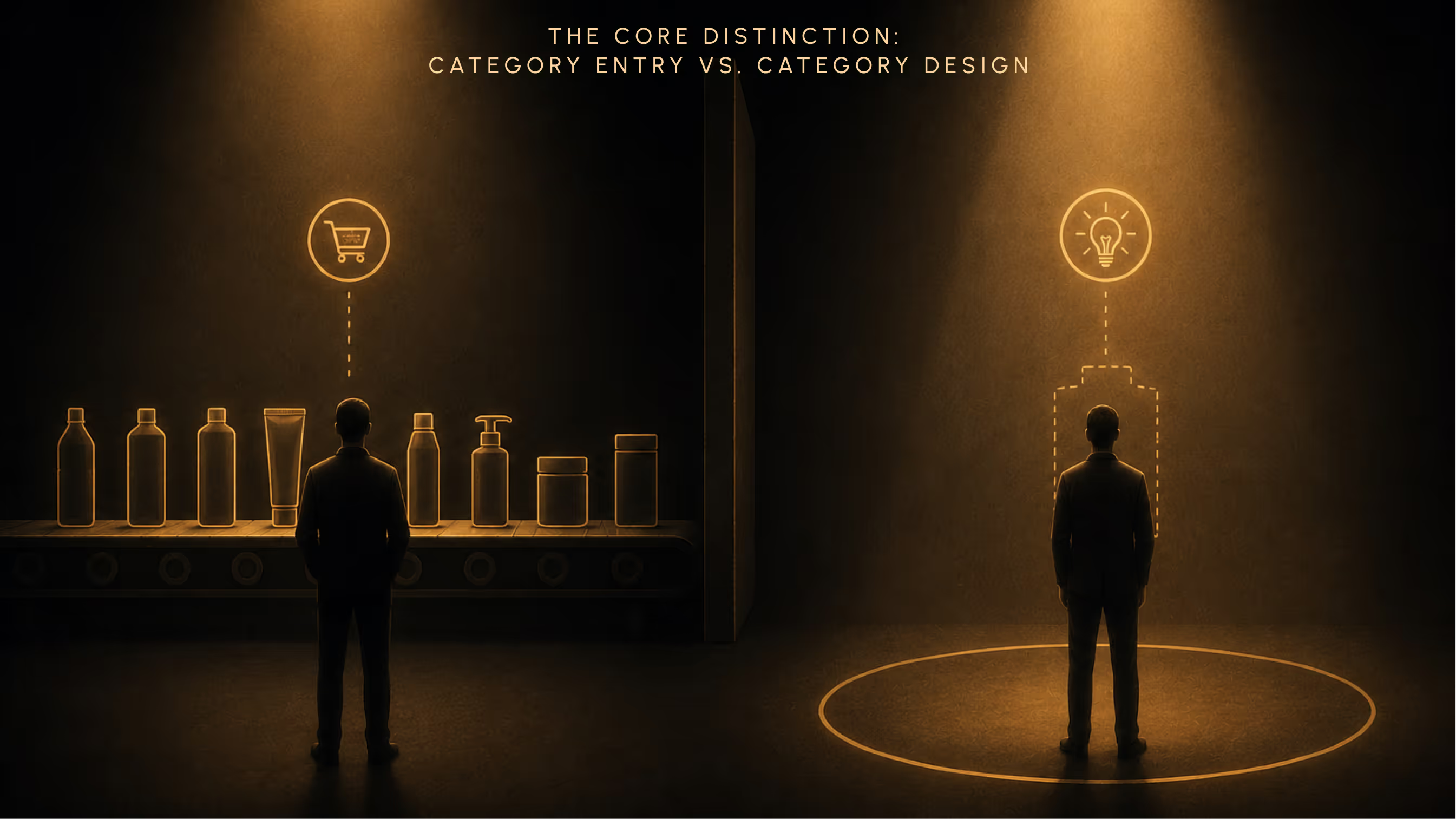
Let me state both positions clearly before complicating them.
A brand that enters a category accepts the market's existing frame for what the problem is. The customer already knows what they are shopping for. The brand competes to be chosen. Success is measured in market share, conversion rates, and awareness within a defined competitive set.
A brand that designs a category names a problem the market did not know it had. Or rather, a problem the market had but had not yet named. The customer does not know they are shopping for this yet. The brand's job is not to win a decision. It is to reframe the decision.
Here is a useful way to think about this: category entrants argue their case before a jury. Category designers write the law before the courtroom exists.
Geoffrey Moore's Crossing the Chasm (1991) is the canonical playbook for category entry. Moore's technology adoption lifecycle assumes the category is already real. The work is moving a product from early adopters to mainstream buyers. It is brilliant on the mechanics of that crossing. What it cannot tell you is what happens before the category exists.
Category design is what happens before Moore's model begins. It is the work of conditioning a market to generate pull before there is a ladder to climb.
Lochhead describes this in Play Bigger as 'conditioning a market to generate market pull.' The four-stage process: name the problem, design the category, develop the ecosystem of believers, become the king. Not through superiority. Through ownership of the frame.
What Category Kings Actually Do: Three Documented Cases
Frameworks are only useful if you can see them operating in the real world. Here are three cases, each following the same structure: what category existed, what frame the brand rejected, what new frame they introduced, and what the commercial result was.
Salesforce: 'The End of Software' (Not 'Better CRM')
In 1999, Marc Benioff founded Salesforce in a market dominated by Siebel Systems, which sold on-premise customer relationship management software. The obvious move: build a better, cheaper CRM.
Benioff chose a different move. He declared the end of the entire on-premise software model.
His mission, as he describes it in Behind the Cloud (co-written with Carlye Adler, 2009), was 'The End of Software.' He did not compete against Siebel on features. He competed against the concept of software itself. In 2000, he staged theatrical protests outside Siebel's user conference with actors carrying 'No Software' signs. Business Insider called Salesforce 'the ant at the picnic.'
The category Benioff was naming was not 'cloud CRM.' It was 'a world without software.' The customer problem he was articulating was not 'I need a better CRM.' It was 'installed software is the wrong model for running a business.'
That frame could not be copied. You either believe the problem or you do not. And once customers believed it, Siebel's entire product philosophy became the thing they were buying to escape.
Salesforce reported $41.5 billion in revenue for fiscal year 2026.
The frame was the strategy.
Airbnb: 'Belong Anywhere' (Not 'Cheaper Hotel')
Airbnb launched in 2008 as a peer-to-peer accommodation marketplace. The category they could have entered: short-term rentals, positioned as a cheaper alternative to hotels. That would have placed them in direct comparison with Marriott, Hilton, and Expedia, on criteria they could not win.
Instead, Airbnb named a different problem: the experience of travelling and feeling like a tourist rather than a person who belongs somewhere. Their category was not accommodation. It was belonging.
The 2014 brand relaunch, designed by DesignStudio in London, made this explicit. The Belo symbol, widely mocked at launch for resembling various body parts, was intentional in its strangeness. It looked nothing like any travel or hospitality brand. That was the point. Airbnb was not in the hospitality category. It was in the belonging category.
Peter Thiel, in Zero to One, describes Airbnb's founding insight as the belief that with the right digital reputation system, strangers could actually trust each other. That was not a product feature. It was a belief about a different future. That is what category design is built from.
You cannot copy belonging. Marriott can build the same rental product. They cannot build the same frame.
Figma: 'Multiplayer Design' (Not 'Better Sketch')
By 2012, Sketch had established itself as the dominant UI design tool, having displaced Adobe Illustrator for interface work. Any new entrant faced the same calculus: build a better Sketch.
Figma rejected the premise. Not the product premise. The categorical premise.
Design, as it was practiced across the industry, was a solitary, file-based activity. Files got emailed. Feedback was asynchronous. Design was separated from the product team by process and by file format. Figma named this as the problem: design is not a solo discipline. It is a collaborative, real-time, team sport. The category Figma named, collaborative design, made every file-based tool feel like it was solving the wrong problem. Not a worse version of the right problem. The wrong problem entirely.
In 2022, Adobe made an acquisition offer of $20 billion for Figma. The deal was blocked by UK and EU regulators in 2023. But the valuation was the verdict: Figma was worth more than the entire Adobe Creative Cloud at the moment of that offer.
The category, not the features, generated that value.
Sketch did not become inferior. It became the wrong answer to the right question.
In each of these three cases, the brand did not compete to win. It competed to define the terms of winning.
If you are trying to work out which side of this divide your startup sits on, that is exactly the conversation we start with at Izart.
The Framework: Five Diagnostic Questions for Startup Brand Strategy
Here are the five questions. Run them against your brief before reading the details.
• Are you naming a problem or entering a solution space?
• Would your category exist without you?
• Can you lose on features and still win?
• Do competitors validate or threaten your category?
• Are you building customer understanding or customer preference?
Run these questions against your current brief. They will tell you which side of the divide you are actually on. The goal is not to push every startup toward category design. It is to make sure you know which game you are playing before you invest in playing it.
I have had founders insist they are category designers, and then fail Question 2 inside the first ten minutes.
Question 1: Are You Naming a Problem or Entering a Solution Space?
Category entrants start with the solution, their product, and look for customers who need it. Category designers start with a problem that does not yet have a commonly accepted name.
The test is clean: can you describe what is wrong with the world without mentioning your product? If no, you are entering. If you can articulate the problem in a way that makes your product the obvious response rather than the obvious product, you might be designing.
Play Bigger frames this as 'frame, name, and claim the problem.' The category design process begins with articulating what Lochhead calls the strategic missing in the world. The product comes later. The problem frame comes first.
Question 2: Would Your Category Exist Without You?

If yes, you are a competitor. If no, or 'not in this form,' you might be a category designer.
The test is not uniqueness. It is causality. Salesforce did not just participate in the SaaS category. They caused it. Airbnb did not join the sharing economy. They named it.
The question a brand strategy agency for startups should be asking every client is not 'how do you stand out?' It is 'are you the product of a market, or the cause of one?'
Question 3: Can You Lose on Features and Still Win?
This is the sharpest diagnostic.
Category entrants cannot afford to lose on features. Features are the only evaluation criteria. If someone ships a faster, cheaper version, the logic of the category demands customers consider switching.
Category designers can lose on specific features and still dominate, because the customer's evaluation criterion is no longer 'which is better' but 'does this brand define the problem I now understand myself to have.'
Apple lost on specifications against Windows PCs for years. Cheaper, more powerful hardware was available. Apple won because they owned the frame. The category was not 'personal computing.' It was 'tools for people who think differently.' TBWA\Chiat\Day's Think Different campaign, launched in 1997 on Steve Jobs's return to Apple, did not advertise a product. It redefined the customer. That frame protected Apple's margins and loyalty through every spec sheet comparison.
Thiel, in Zero to One, argues that proprietary technology needs to be 10 times better than the next best option to matter in a competitive market. But if you own the category, you do not need 10x. You need a compelling enough problem frame. The evaluation criteria shifts from 'which is better' to 'do I believe this is the right way to understand the problem.'
This is also why Apple's launch of the iPhone in 2007 is worth examining here. The smartphone category existed. BlackBerry had defined what a smartphone was for enterprise professionals. Apple did not compete inside that category. They built a new one: a computing device that happened to make calls, for people who thought of their phone as an extension of how they moved through the world. The category they named was not 'better smartphone.' For more on how Apple created demand for a product nobody knew they needed, that mechanism is worth its own examination elsewhere on this site.
Question 4: Do Competitors Validate or Threaten Your Category?
For a category entrant, a well-funded competitor entering your space is a threat. Margin pressure, rising customer acquisition costs, differentiation becoming harder.
For a category designer, a competitor entering your space is validation. It confirms the category is real.
Lyft entering the ride-sharing market did not fragment the category. It confirmed the category existed. Uber responded with more category language, not defensive product language. 'Everyone's private driver' doubled down on the frame. Play Bigger documents that category kings capture approximately 76% of market cap regardless of who enters later. When a competitor arrives, the category designer accelerates. The entrant flinches.
Question 5: Are You Building Customer Understanding or Customer Preference?
Category entrants compete for preference. 'Choose us over them, for these reasons.' It is a rational argument made to a customer who has already framed the decision.
Category designers compete for understanding. The customer needs to see the world differently before they can evaluate the product at all. If your brand communications are trying to win a decision that the customer has already framed in someone else's terms, you are entering. If your communications are trying to reframe the decision itself, you are designing.
April Dunford makes this practical in Obviously Awesome (2019): before any positioning work can land, the customer needs to understand what context they are evaluating the product in. Category designers build the context. Category entrants compete inside one.
This is why category design is upstream of marketing. It determines what marketing is even trying to accomplish. Why demand follows belief rather than awareness is something I have written about at length elsewhere on this site, and it connects directly here: the belief system that drives demand starts with the category frame, not with the campaign.
What This Means in Practice: How the Work Changes
When a startup is genuinely designing a category, the work a brand strategy agency for startups does looks different across three dimensions.
The Brief Changes
Category entrants brief an agency on competitors, market size, and target audience. Category designers brief on the problem they believe exists in the world that no one has named yet, and why they are uniquely positioned to name it.
The brief for a category designer starts with a worldview, not a product. A brand strategy agency for startups that does not know how to receive a worldview brief is not equipped for category design work.
The first artifact in category design is not a logo or a positioning statement. Play Bigger calls it a Point of View document: a worldview statement that names the problem, articulates why it is unacceptable, and makes the case for why a new category needs to exist. If a client cannot write that document, or is not ready to, they are in category entry mode. Which might be exactly right for where they are. But both parties should know which game they are playing.
The Strategy Changes
Category entry strategy is about positioning against alternatives, articulating differentiation, and building preference. Category design strategy is about naming the problem, building the ecosystem of people who believe the problem is real, and creating the demand infrastructure before the sales infrastructure.
Brand strategy for startups in category design mode is less about 'how do we compete' and more about 'how do we make the old way feel broken.' That work starts with the category frame, not the campaign, and it is why demand creation strategy is a distinct discipline from brand awareness.
The Visual Identity Changes
A category entrant's visual identity signals quality within a known register. It looks like it belongs in the category, but better. A category designer's visual identity creates a new register entirely.
This is why category design identities often look wrong at first. They are not calibrated to the existing category's aesthetic norms because they are not claiming to be in that category. The Belo was mocked in 2014 because it looked nothing like a travel brand. That was the proof it was working. Airbnb was not in the travel category. It was in the belonging category. The identity was correct. The viewer's frame of reference was not.
Frequently Asked Questions
What is the difference between category design and brand positioning?
Positioning is the work of establishing where your brand sits relative to other options in a customer's mind, within an existing category. Category design is the work of building the category itself. Positioning asks 'where do we stand?' Category design asks 'what is the customer standing inside?' One is a real estate decision. The other is urban planning.
How can a startup use category design without the resources for a large brand campaign?
Category design is not primarily a communications investment. It is a thinking investment. The first move is naming the problem clearly and consistently across every touchpoint: investor decks, product copy, sales conversations. The category gets built before the campaign gets launched. Salesforce staged protests for a few thousand dollars. The frame cost nothing. The conviction cost everything.
What does a brand strategy agency for startups do differently for category designers versus category entrants?
The work begins upstream. For category designers, the agency's first output is not a logo or a positioning statement. It is a point of view document that names the problem, articulates the worldview, and maps the ecosystem of who needs to believe it. Visual identity and messaging follow from that. The sequence is: problem frame, then ecosystem, then identity, then campaign.
Can every startup practise category design, or only certain types?
Not every startup has a genuine category design opportunity. Category design requires a real, nameable problem that is not yet named: what Play Bigger calls a strategic missing in the world. If the problem is already named and the market is defined, the honest answer is category entry done well: sharp positioning, genuine differentiation, and a clear category leadership ambition. Both are legitimate strategies. Neither is easy.
The Frame Is the Strategy
Go back to the founder in the opening scene. The one with the clean deck and the competitive landscape matrix.
After sitting with this framework, their question shifts. Not 'how do we look better than the alternatives?' but 'what problem are we naming, and does anyone else name it the way we do?'
That is a different brief. It produces different strategy, different identity work, and different commercial outcomes.
Most brands will enter categories that already exist. That is not a failure. It is a legitimate strategic choice, and category entry done with rigour and genuine differentiation produces better outcomes than category design done with borrowed language and no real conviction.
But if you want to build something that compounds in value rather than competes for margin, the question is not 'how do we win?'
It is: who gets to decide what winning means?
The companies that answer that question first tend to answer it for everyone else.


Continue
Reading

Best Branding for Startups: Differentiation vs. Distinction
Most branding work for startups delivers a style guide. A style guide governs what a brand looks like. A signal system governs what a brand makes people feel, recall, and associate, at every touchpoint, over time, without being reminded. The difference between the two is the difference between a brand that is different and a brand that is unmistakable.


What Visual Identity Is Actually For (And What AI Cannot Replace)
The designer who cannot articulate the argument behind each element of a mark has not made a design decision. They have made a visual guess. AI generates visual guesses that look like design decisions. The difference is not immediately visible. That is exactly the problem.

Sustainable Packaging Is Brand Identity, Not Just Ethics
The brands that have built durable advantage through sustainable design share almost nothing in common, except this: the packaging choice was an expression of what the brand already believed about itself, not a response to what regulators or critics required.