Here’s The Branding Playbook We Used to Design 40+ Successful Brands
May 12, 2025




I’ll start with a confession.
It’s three in the morning, I just finished writing this piece, and a part of me actually wanted to gatekeep this blog.
Simply because of the value this piece holds.
What you’re about to read is not just another write-up.
It’s a complete breakdown of how our creative studio, executes brand identity projects. All the systems, workflows, and methodologies we’ve spent years refining condensed into one 10-minute read.
No vague platitudes about “finding your brand voice” or surface-level pretentious BS that plagues the creative space.
Instead, I’m giving you our complete playbook we use to deliver impactful branding projects for clients across industries.
Why am I doing this?
I’m not so sure.
Perhaps it's because I'm tired of the mystique that surrounds creative work.
The idea that great brand identities emerge from some nebulous creative process where talented people stare at the ceiling until inspiration strikes is honestly kind of misleading.
The true nature of creative work is far more pragmatic, systematic, and, honestly, much more interesting.
So whether you’re considering hiring a branding studio, working to build one yourself, or building your own brand, I hope that this blog will demystify this process and help you design impactful brands.
Okay, enough foreplay.
Let’s just dive into the good stuff: the structured chaos that is our branding methodology.
The First Touch(point)
When any potential client reaches out, we enter what I consider one of the most crucial phases of our process: brief development.
In my experience, businesses rarely have formal documentation for what they’re looking for. They have a broad understanding of their requirements, but we usually don’t expect them to show up at our doorstep with a detailed brief.
Often, they’ll approach us with vague statements like “We need a rebrand” or “Our packaging isn’t working,” but struggle to define the specific problems or desired outcomes.
That’s why our discovery session involves us asking in-depth questions, listening intently, and then—this is key— framing a requirement brief on their behalf and getting it vetted by them.
This reversal of the typical client-agency dynamic gives our prospects confidence that we, as their creative partner, understand their needs intimately (sometimes better than they do themselves).
Once the brief is approved, we create a solution document (pitch)
Since branding is inherently personal for every brand, we don’t try to commoditise it internally.
Every solution document we create is different. And we tailor them to add maximum impact to that particular client’s growth trajectory. And even though branding isn’t exactly an ROI-driven activity in the traditional sense, we still aspire to add tangible value at every step.
The way we achieve this is by modulating our offerings to the client’s industry and challenges:
- For an enterprise SaaS company, we might focus more deeply on brand strategy, ICP identification, whitespace analysis, offer creation and promotion rather than just flashy motion graphics. This is because their customers are making intentful purchases solely on perceived value and trust.
- For a consumer brand in a crowded category, our services might skew toward building a differentiating brand narrative, creating scroll-stopping visuals, and designing consistent yet distinctive packaging across their SKU range.
The key is that we don’t force clients into a one-size-fits-all approach.
Instead, our job is to act as a launchpad for businesses by curating services for their specific needs, not forcing them into our existing mould.
The Tightrope of Structure and Creation: Our Design Process
While our solution documents are customised for each prospect, we do follow a stringent set of internal SOPs to execute the work. This framework gives us the structure needed to consistently deliver exceptional work while still allowing for creative flexibility.
Once a prospect becomes a client, our process unfolds in six phases:
1. The Onboarding
We send a customised questionnaire to get deeper insights into the brand.
Now this isn’t your usual “What’s the mission of your business?” type of questionnaire. The one we share usually forces the founders to sit down and reflect on the core fundamentals of their business.
We ask questions like, “If you were living in a communist state and you couldn’t make money from this venture, would you still build it, and why?”
Granted, these questions might sound absurd, but they help us unlock a brand story from the founder that maybe they did not even know existed.
For example, last year, we worked with a founder who was developing sustainable tableware. For the launch, he had in mind a typical narrative of a sustainable company.
However, through his answers, we uncovered a profoundly personal story.
The founder was brought up in the northern part of India, which is prone to forest fires. While these forest fires are seasonal and somewhat predictable, they are accelerated due to the highly flammable nature of pine needles. As a kid, he would collect these pine needles by hand to protect the forest he loved.

Later, he spent years researching ways to use these pine needles and came up with a method for turning them into a plastic-like polymer that could be moulded into tableware.
Now just compare this story to a typical “we are a sustainable alternative to plastic” narrative.
The impact is just miles apart.
Funnily enough, in a couple of cases, the founders have even reverted back to us to ask for an extension to start the project because while answering our questions, they discovered new markets and offerings they didn’t think about before. (Kinda shot ourselves in the foot there, but since our core aim is to help the brand, I still count this as a win.)
2. Market Analysis
Using the insights gathered, we conduct a thorough market analysis to find the intersection of three critical elements:
- Consumer expectations: What do customers in this category expect and demand?
- Market standards: What are the established norms and conventions in this space?
- Scope of creativity: Where is there room to innovate without alienating the target audience?
This analysis helps us define our creative constraints — ensuring that the output we deliver is not just creative but also solves the core purpose of growth.
I’ve observed that many creative studios just aim for boundless ideation. However, in most cases, the resulting identities look spectacular on Behance but fail to perform well in the marketplace.
Primarily because they weren’t built on empirical data showing positive customer responses to that creative direction.
That’s why I push my team to work as data-driven creatives.
Don’t design things that just look good; design things that work
This means sometimes pushing back against client preferences or designing elements that might not look impressive in a portfolio but would get the target customer to pick up the product and buy it without friction.
3. Creative Direction Development
Contrary to popular belief, creative ideation is not an abstract concept of “when inspiration strikes”; it comes from following a routine.
Believe it or not, I learnt this from Eminem.
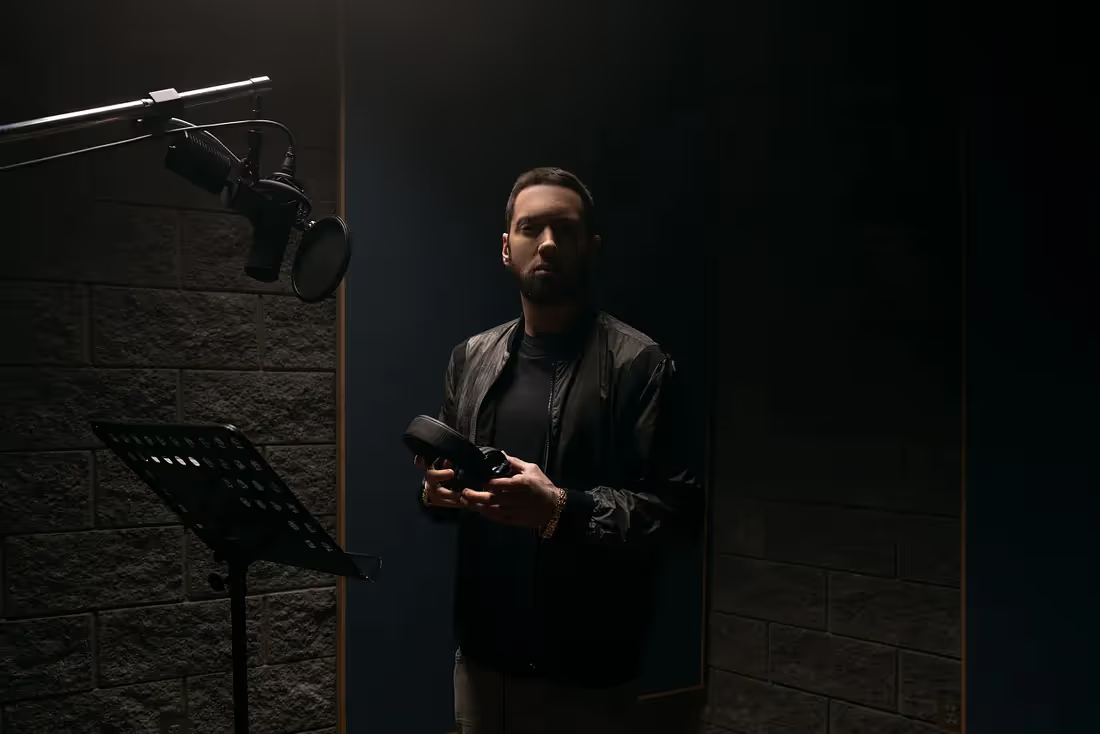
In an interview, Akon revealed that Eminem approaches being a musician as a 9–5 job. He arrives at a fixed time and he leaves at a fixed time. And within that schedule, he delivers verses good enough to win Grammys and create a lasting cultural impact.
We work similarly. We hold daily brainstorming sessions with our team at 10AM every day for all open projects. These sessions follow predefined structured creative frameworks to generate ideas.
Now I’ll be honest, breaking down these creative frameworks is beyond the scope of this blog (stay tuned for the next blog), but the key point is that we don’t just throw ideas at the wall to see what sticks.
We use the research we’ve done to answer two big questions:
- What is the Brand’s Story
- What is the Big Idea
To give a visual vocabulary to the answers to both these questions, we start creating visual moodboards.
Each moodboard represents a distinct strategic direction, curated to illustrate how different creative approaches might manifest across the brand ecosystem. We typically present 2–3 distinct directions, each with:
- A strategic rationale explaining how this direction addresses the brief
- Visual references showing color, typography, imagery, and texture applications
- Analogous brands that successfully employ similar approaches
- Preliminary messaging examples that complement the visual direction
I recall working with an enterprise workflow automation platform that simplified complex business processes through automation. While building the product, they largely patched together a rough brand identity without much thought. But after getting their initial traction, they wanted a consistent brand identity framework to establish themselves as a trustworthy company at a macro level.
To kickstart the visual identity process, we presented them with three distinct directions:
- The first direction followed category conventions of blue-and-white SaaS identity with subtle refinements.
- The second direction leveraged neomodern grotesque typography with a saturated colour palette within the same family of colours as the first direction.
- The third direction presented a dynamic visual system, featuring a rich purple as the primary colour, with accents of gold, green, and blue, complemented by an approachable sans-serif typography system.
The leadership team initially leaned toward the conventional approach, concerned about alienating conservative enterprise buyers. But when we examined the decision-making journey of their most successful customer acquisitions, we discovered that standing out early in the consideration phase was the key for initiating deeper conversations.
They ultimately selected the third direction instead of the industry-standard Salesforce blue or Monday.com’s bright primaries.
And within two quarters, their sales team reported a 40% increase in response rates to cold outreach, and their average sales cycle shortened by nearly three weeks.
We stop ideation as soon as we finalise the creative direction with the client.
This approach is highly effective because constant ideation paralyses execution.
With the final creative direction, we define a comprehensive design and motion graphic brief for our team to take forward.
Now the job is to bring the final vision to life.
4. The Design Process
Our design process follows a top-down structure:
- We start with the big picture, like colour palettes and typography systems. These foundational elements set the tone for the entire identity and must work harmoniously across all applications.
- Then we move toward finer details such as textures and patterns. These elements add depth and personality to the brand, creating distinctive visual cues that can be recognised even when the logo isn’t present.
- From this ecosystem, the logomark/wordmark organically emerges to complement the entire identity. By the time we reach this stage, the visual language is so well-defined that the logo becomes an extension of the established system rather than its centrepiece.
Some designers work in a bottom-up manner, starting with the logomark and building outward from there. Personally speaking, there’s no right or wrong method, but we believe that since our core pitch is that a brand is more than its logo, our process’s foundational element shouldn’t be that either.
Once the core visual identity is complete, we tackle finer details:
- Responsiveness of all defined systems: How do elements adapt across digital and physical contexts?
- Imagery guidelines: Photography style, illustration approach, iconography systems
- Brand collaterals: Business cards, letterheads, presentation templates
- Social media templates: Post formats, story templates, content frameworks
- Motion graphics: How the brand moves in digital spaces
Each of these elements is developed with the same level of consideration and strategic intent as the primary brand assets. We believe that a brand is experienced through these touchpoints more often than through the logo alone, so they deserve equal attention.
5. Packaging
If the client requires packaging, we design prototypes congruent with the approved design system. Here’s where our data-driven approach really shines:
- We create prototypes using a mock name/logomark.
- We run cold email campaigns targeting 2,000–3,000 people within the predefined ICP of the brand to measure actual engagement and preference.
- We show them multiple prototype designs and finalise the packaging system based on actual customer responses.
A few years ago, we worked with an organic snack brand that was struggling to stand out in a sea of kraft paper and muted colours that had become the visual shorthand for "natural ingredient" products.
Our testing revealed that their target audience — busy parents who wanted healthy options for their kids — responded much more positively to vibrant design layouts that abandoned the "natural" visual cue but stood out on shelves for kids.
This went against the client’s initial vision, but since the data revealed a clear truth, convincing them with the pivot wasn’t a challenge.
6. The Final Delivery
Once all assets are approved and finalised, we deliver three comprehensive documents to the client:
- The Brand Strategy Document: Contains the brand narrative, ICP segmentation, communication pillars, brand story, messaging guidelines, copywriting, tagline, brand thesaurus, whitespace analysis, and whatever else we pitched under strategy.
- The Brand Deck: This is a beautiful compilation of all visual identity elements. This is the stuff you typically see showcased on Behance.
- The Asset Package: All open, editable, and print-ready files.
We typically offer continued creative support to our clients through a monthly retainer. This arrangement allows us to maintain the integrity of the brand as it evolves and expands to new touchpoints and channels.
However, if the client wants to build an in-house creative team for day-to-day operations, we have a full-day handoff session with their in-house designers, copywriters, and motion graphic designers to walk them through the brand’s usage guidelines.
After project completion, we send all our clients a feedback form to gather their thoughts on our work and process. We’re constantly improving our internal methodologies and remain receptive to constructive criticism.
In fact, the entire workflow I’ve shared in this blog has evolved through continuous feedback loops with our clients. Some of our most effective processes were developed in response to challenges or friction points identified by past clients.
In the end, great branding isn’t magic — it’s methodical.
But when done right, it can certainly feel magical.


Continue
Reading

Best Branding for Startups: Differentiation vs. Distinction
Most branding work for startups delivers a style guide. A style guide governs what a brand looks like. A signal system governs what a brand makes people feel, recall, and associate, at every touchpoint, over time, without being reminded. The difference between the two is the difference between a brand that is different and a brand that is unmistakable.
What Visual Identity Is Actually For (And What AI Cannot Replace)
The designer who cannot articulate the argument behind each element of a mark has not made a design decision. They have made a visual guess. AI generates visual guesses that look like design decisions. The difference is not immediately visible. That is exactly the problem.

Sustainable Packaging Is Brand Identity, Not Just Ethics
The brands that have built durable advantage through sustainable design share almost nothing in common, except this: the packaging choice was an expression of what the brand already believed about itself, not a response to what regulators or critics required.