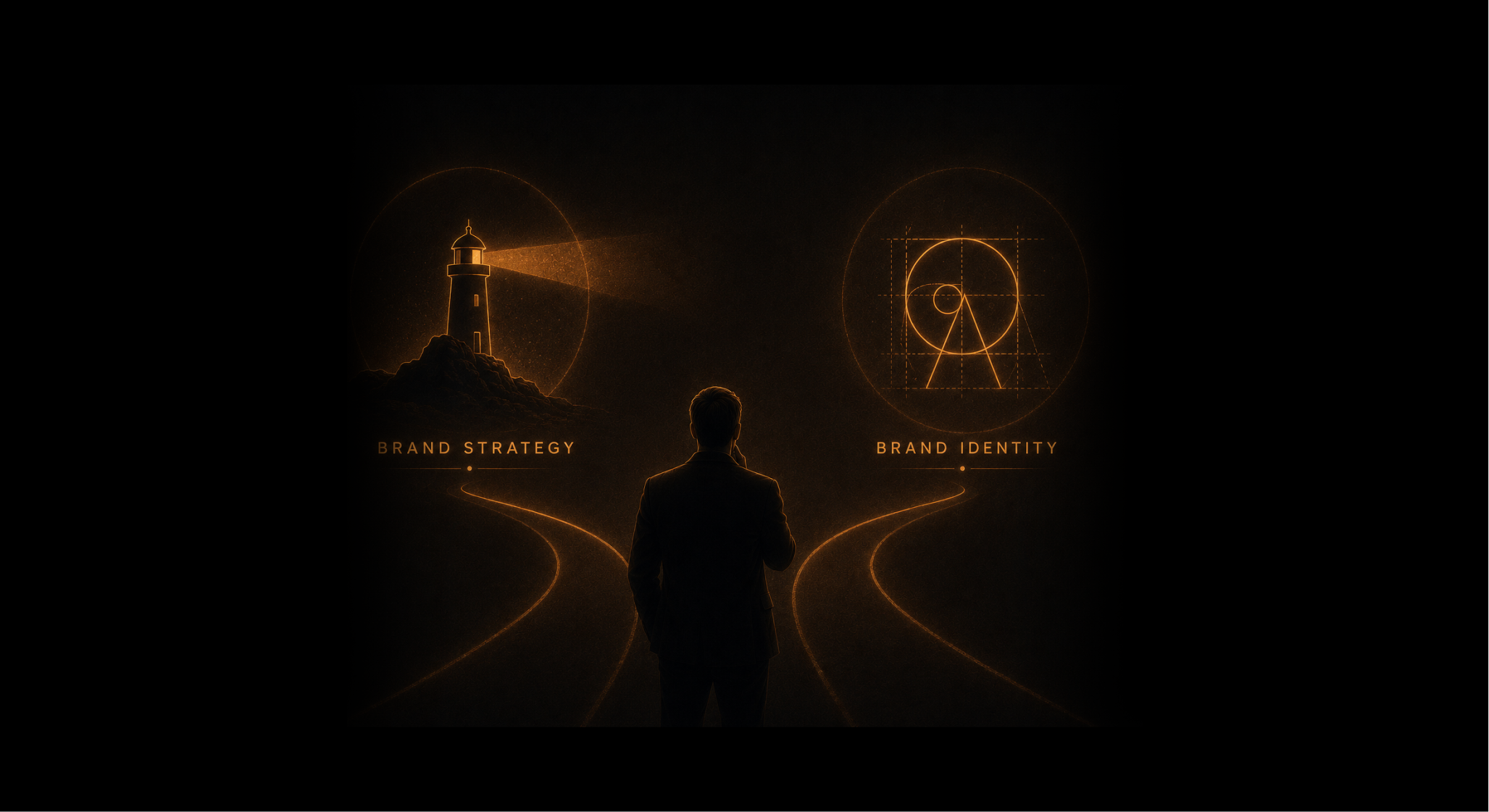
What Is Brand Strategy? Not a Logo.
May 20, 2026

The pitch deck is ready. The product is in beta. The bank account has runway. And the first thing the founder does is open a Fiverr tab and type: logo design startup.
Here is what brand strategy actually means for a startup, and why it has to exist before a single pixel gets drawn. Most founders never ask this question. Most founders spend their first design budget before they can answer it.
That is the most expensive mistake in early-stage brand building.
Table of Contents
1. The Misunderstanding That Costs Thousands
2. What Is Brand Strategy, Actually?
3. Why Founders Jump Straight to the Logo
4. What Happens to Brands Built on Logos Alone
5. The Correct Sequence (Before You Brief a Designer)
6. Frequently Asked Questions
The Misunderstanding That Costs Thousands
Here is where the instinct comes from.
Apple. Nike. Google. The most recognizable companies in the world are, to everyone who encounters them, a mark. A bitten apple. A swoosh. A colored G. We are trained by decades of consumer experience to equate the visual symbol with the brand itself. The logo is the most visible thing, so it reads as the thing.
It is something else entirely.
Those marks are downstream of decades of positioning, verbal identity, and cultural accumulation. What founders see when they look at the Nike swoosh is the output of a strategy that has been running since 1988. They are seeing the residue of a brand compressed into a shape the market now recognizes.
The strategy came first. The symbol came later.
When the Visual Comes First, It Carries Nothing

A logo's function is to symbolize and recall an idea that already exists in the market's mind. That is the entire job. When someone sees the Apple mark, they access a constellation of associations: premium, minimal, creative, trustworthy. The logo recalls those associations. It does not produce them.
If the idea does not yet exist, because positioning, ideal customer, and verbal identity remain undefined, the logo has no idea to recall.
It is a shape.
Gap demonstrated this in 2010. Facing slumped sales after the financial crisis, the company redesigned its 20-year-old logo with no repositioning strategy behind it. No new market definition. No reason to change. The new mark survived six days before Gap reversed course. What failed was the absence of a strategic argument beneath the redesign. The visual was asked to do work that the strategy had never done.
What Serious Branding Firms Actually Do

When Pentagram or Wolff Olins takes a brief, the majority of billable hours happen before any concept is sketched. Discovery. Competitive positioning. Audience mapping. Verbal identity. The entire opening phase of a serious brand engagement is language and logic, not pixels.
Founders rarely see this process. They see the invoice for the final logo.
That gap in visibility creates the illusion that brand equals visual identity, when visual identity is the final phase of a much longer argument.
What Is Brand Strategy, Actually?
What is brand strategy? It is the set of decisions that precede and enable visual expression. Who you are for. What position you claim in the market. What you sound like. What values your visual identity will eventually carry. What you stand for before anyone is watching.
Without that foundation, a designer cannot make a meaningful logo. They can make an aesthetic one.
Aesthetics and meaning are different things.
David Aaker, whose 1996 book Building Strong Brands remains the foundational academic treatment of brand identity, places the logo in the extended identity layer, not the core. The core encompasses values, purpose, and organisational culture. Visual marks symbolize core identity. They do not constitute it.
Getting that foundation defined before anything else is commissioned is the entire point of the brand strategy process, and why a poorly written brand brief produces poor design work regardless of the designer's talent.
The Five Things a Logo Cannot Do
A logo cannot position you in a category — and brand differentiation and brand distinction, while related, are two different strategic challenges that both require strategy to resolve.
● It cannot create a tone of voice.
● It cannot define your ideal customer.
● It cannot articulate your value proposition.
● It cannot build trust through repeated consistency of message.
These are strategy tasks. Every one of them has to be answered before a designer can make anything that carries meaning. The logo can only reinforce answers that already exist. It cannot generate them.
Al Ries and Jack Trout made this argument definitively in Positioning: The Battle for Your Mind (1981): 'Positioning is what you do to the mind of the prospect.' The market contest is won in language and mental space before any visual asset exists. A logo can only symbolize a position that has already been claimed in language. It cannot claim one.
What Comes Before the Logo
Here is the correct sequence:
1. Brand positioning: who you are, for whom, and what market position you claim.
2. ICP definition: who specifically is the first believer, named precisely.
3. Value proposition: what you are promising and what makes that promise credible.
4. Verbal identity: tone of voice, vocabulary, messaging hierarchy, the things the brand will never say.
5. Visual identity: logomark, colour system, typography.
The logo is fifth.
Why Founders Jump Straight to the Logo
Because strategy is abstract, and a logo is concrete.
A founder under pressure to pitch, to send a deck, to present at a meeting, needs something tangible to show. A logo delivers the illusion of readiness. It looks like brand building. It feels like progress.
Motto, in their analysis of early-stage branding mistakes, describes the trap with precision: 'You make a logo, spin up a website, draft some ideas, and call it a brand. From the outside, it works.'
From the outside. That is the whole problem.
The Legitimacy Trap
When a logo is purchased before strategy exists, it is performing a psychological function for the founder, not a communicative function for the audience.
The founder feels more legitimate. The audience encounters a visual with no idea behind it, no clear positioning, no consistent voice, and forms no durable memory of the brand.
Marty Neumeier wrote in The Brand Gap (2003): 'Your brand isn't what you say it is. It's what they say it is.'
What the founder chose to signal (legitimacy) and what the audience actually receives (a shape with no story) are two different things. The logo was doing the wrong job from the very beginning.
The Pivot Problem
Early-stage companies pivot. The positioning shifts. The ICP refines. The category evolves.
A logo built before strategy was defined now needs to change with everything else. But it cannot, because it was never connected to a strategic idea in the first place. A logo built after strategy survives a pivot, because it expresses values rather than reacts to tactics. Values are stable. Tactics shift.
Strategy-first brands rebrand less. That pattern is consistent.
What Happens to Brands Built on Logos Alone
They survive until scale.
At Series A, or when the first CMO joins, or when the PR team needs brand guidance, there is nothing to work from. No verbal identity to hire against. No positioning to build a marketing function from. The logo is doing work it was never designed to carry.
The Rebuild Cost
Every agency brief that opens with 'we need a rebrand' usually should have been a strategy conversation 18 to 24 months earlier.
The cost of rebuilding positioning, verbal identity, and visual identity post-launch is multiples of the cost of doing the work correctly at the start. The logo was inexpensive. The rebrand is expensive.
The rebrand is not even the real cost. The real cost is the two years of brand incoherence that preceded it: mixed messaging, an inconsistent hiring pitch, a website that contradicts the sales deck, a PR team with no coherent angle. That incoherence accumulates on every invoice it never appears on.
This is why rebranding is a strategy problem at its root, and why it costs so much more than it should have.
The 1988 Nike repositioning is the inverse of the whole argument. Facing competitive pressure from Reebok, Nike did not redesign the swoosh. They redefined the positioning. 'Just Do It' was a strategic shift: a move from performance equipment for elite athletes to identity brand for everyone. The swoosh barely changed. What changed was the verbal identity, the audience definition, and the cultural claim.
When strategy is done well, the logo barely needs to move.
If your team is already in this situation — decent product, unclear brand, approaching a fundraise — Izart’s brand strategy sprint is where we begin.
The Correct Sequence (Before You Brief a Designer)
Here is the sequence as a working reference:
1. Brand positioning. Define who you are, for whom, and what market position you claim. This is the foundation everything else is built on.
2. ICP definition. Name your first believer precisely. 'Ambitious founders' is not an ICP. A specific person with a specific problem and a specific reason to choose you is.
3. Value proposition. What are you promising, and what makes that promise credible?
4. Verbal identity. What does the brand sound like? Tone of voice, vocabulary, messaging hierarchy, the things the brand will never say.
5. Visual identity. Logomark, colour system, typography. Brief the designer now. The designer has something real to symbolize.
The logo is the last decision, and the first thing everyone sees.
That asymmetry is the whole problem.
Frequently Asked Questions
What is brand strategy and why does it matter for startups?
Brand strategy is the set of decisions that precede and inform visual identity: positioning, audience definition, value proposition, and verbal identity. For startups, it matters because every downstream decision, from hiring to pricing to product naming, becomes clearer when strategy is defined. Without it, each decision is made in isolation, and the brand accumulates contradictions rather than clarity.
Should I build a brand strategy before getting a logo?
Yes, always. A logo is a visual shorthand for an idea. Without the idea, the logo has nothing to abbreviate. For pre-product companies at minimum-viable branding, a clean wordmark works as a placeholder. The full brand strategy process, positioning, ICP, value proposition, verbal identity, comes before visual identity regardless of stage.
What comes before a logo in the branding process?
Brand positioning, ICP definition, value proposition, and verbal identity all precede the logo. This is the founder's work, usually with a strategist. Skipping it produces a visual identity that cannot scale, cannot survive a pivot, and cannot support a marketing function. The brief that starts with 'we need a logo' almost always means 'we skipped the strategy.'
What is the difference between a brand and a logo?
A brand is the sum of perceptions a market holds about a company, shaped by positioning, behaviour, language, and consistency over time. A logo is a symbol that can recall that brand once it exists in the market's mind. Marty Neumeier defined it precisely in The Brand Gap: 'A brand is a person's gut feeling about a product, service, or company.' A logo without a brand behind it is a shape.
The Logo Is the Last Decision
Go back to that founder with the Fiverr tab open.
They are correct to want a logo. The logo will matter. Eventually, it will carry everything the brand has built. But right now, with the product in beta and the strategy undefined, the logo cannot carry anything. There is nothing yet to carry.
The founders who build brands that last spend their first brand budget on questions. Who is this for? What do we actually believe? What position does no one else own? What does this company sound like when it speaks? They answer those questions with precision. Then they brief a designer.
The logo is the last thing you decide.
It is the first thing everyone remembers.
Build it last, and it earns its place.