The Future of Branding is in Subcultures not Spreadsheets
October 13, 2025





I’m going to say something that can get me in a lot of trouble.
But here it goes;
Data Driven branding is probably going to ruin your brand.
Now before you roll your eyes thinking I am about to give a rant on how data driven decisions are taking the soul away from my oh so artistic work, let me stop you right there.
I’m no purist.
In the past 40+ branding projects I have worked on, my only goal is to get my clients commercial success. It’s just that the secret sauce of building legacy brands is not rooted in data at all.
It’s rooted in something that no big brand wants you to know.
But if you spend the next 7 minutes with me, you’re going to walk away with an actionable guide to add it to your arsenal.
But first, let’s zoom out a bit.
We all love good data.
With exceptional data scrapping, you can find topics that interest your potential customers. You’ll know their engagement patterns, their shopping history, the spikes in searches of specific keywords, their geolocation segmentation, and probably a bunch of other technical stuff that I’m probably missing out on.
But one thing it can never tell you is…intesity of connection.
Data can’t help you understand out of the 10 reels your consumer liked, which piece of content touched their true desires and which one was just a minor chuckle.
Out of the 10 purchases they made, which one was driven by impulse and which was driven by thoughtful intent.
Meaning > Metrics
But if not data, then what is the anchor point for making any branding decision?
I’ve got one word answer for you;
Culture.
Brands that have stood the test of time have always attached themselves to the culture of their target audience.
Take a company like Bata for example.
I always assumed Bata to be an Indian company. But at the same time any country Bata operates in thinks of it as their native country’s company.
How?
Because Bata attached itself into every geography at such a grassroots level where townships are named after their brand. Their ads and their positioning is hyperlocalised to the point that they not just speak the language but also adapt to the vernacular of their customers.
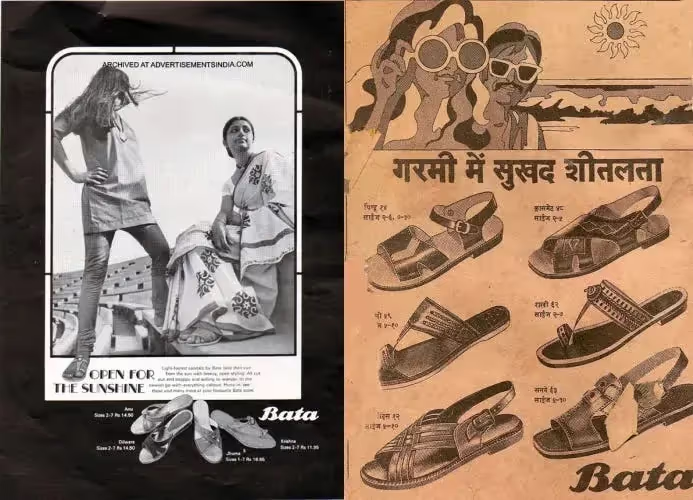
They dominate GT by providing lucrative margins to distributors and local shopkeepers to the point where every small shoe store becomes a brand evangelist.
If this sounds like too much work, the good news is that as a brand building in 2025, aligning yourself to a culture no longer requires such heavy capital investment.
Case in point: Liquid Death
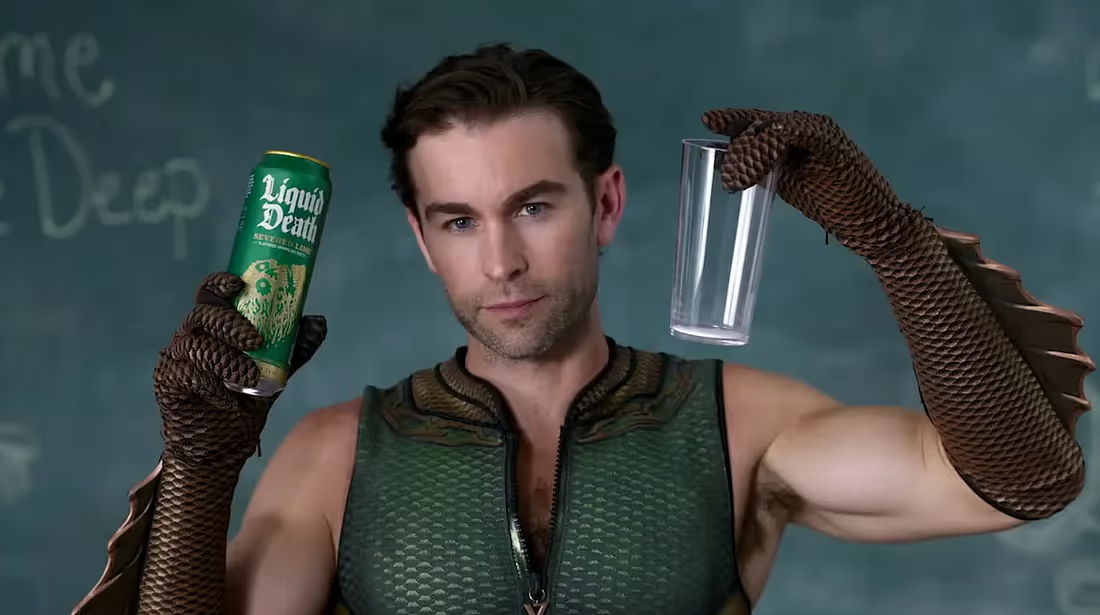
Think about the canned water company Liquid Death.
Liquid Death used branding steeped in punk, metal, and extreme sports aesthetics such as tallboy cans, metal-inspired typography, which made drinking water feel “dangerous” and rebellious. It essentially won by branding water like beer.
To outsiders, it’s a quirky can, but to those familiar with the subculture, every design choice signals belonging and attitude.
And with this one authentic connection, in a red ocean of companies selling water bottles, they now operate in a category of one.
Or Marine Serre, branding for a broken world
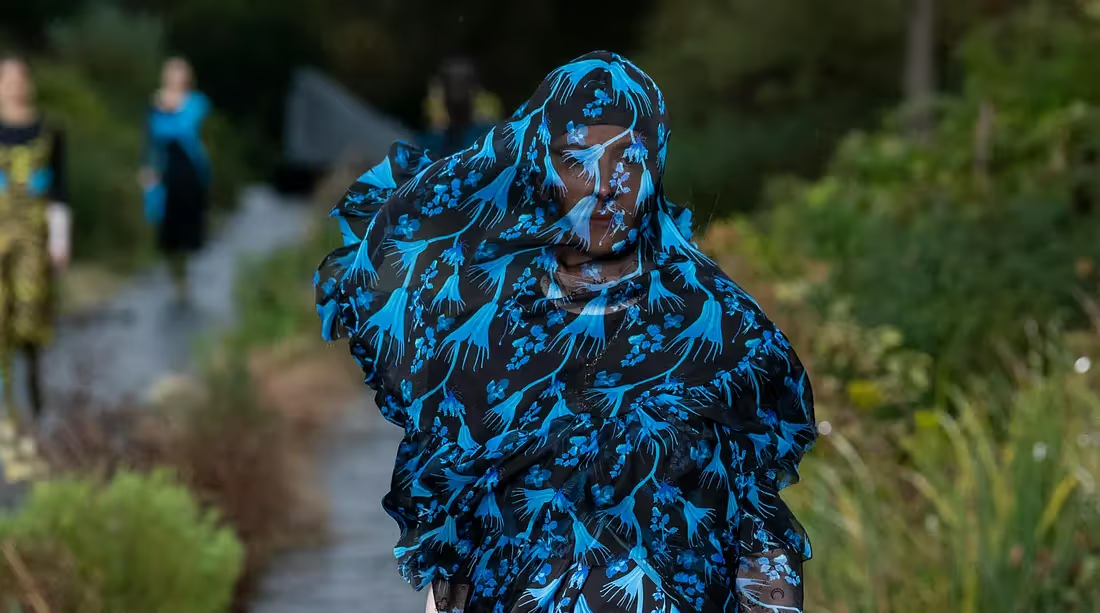
Marine Serre, who built her fashion empire on what most designers would consider unmarketable: existential dread.
She started creating clothes for a generation that felt like the world was ending — literally. Climate change, cultural displacement, identity confusion — all the things focus groups would scream: avoid.
But she did not sanitize these anxieties, she leaned into them. Her crescent moon became a secret handshake for young people who felt caught between cultures and catastrophes.
She’s creating uniforms for a tribe that already existed. People who were already piecing together new identities from the fragments of a fractured world.
Both these brands didn’t wait for data to tell them what people want. They already knew what people felt and built brands that reflected those feelings before the spreadsheets caught up.
What most fancy looking dashboards won’t tell you is that people don’t want to be targeted.
They want to be seen.
They want to belong to something that feels bigger than a purchase decision.
Don’t attract everyone but mobilize someone.
Now conventional wisdom would dictate that this would narrow your audience to niche communities. But it actually expands it.
Because while subcultures might start small, the human need to belong is universal. Done right, your underground movement becomes the thing that cool kids, soccer moms, and CEOs all want to be part of, each for their own reasons.
This is where branding stops being about selling and starts being about belonging.
Now that the premise clear, let’s explore the actionable roadmap you can use to bring this insight to your brand.
The Basics of Subculture Targeting
You can’t fake your way into a subculture. Targeting subcultures starts with actually giving a damn about something.
This essentially means your brand needs to feel like it belongs in the scene, not like it’s crashing the party with a clipboard and a focus group budget.
Real subcultures emerge from frustration, mainstream status quo, the way things are supposed to be. And if you aren’t authentic about it, things can go sideways really quickly.
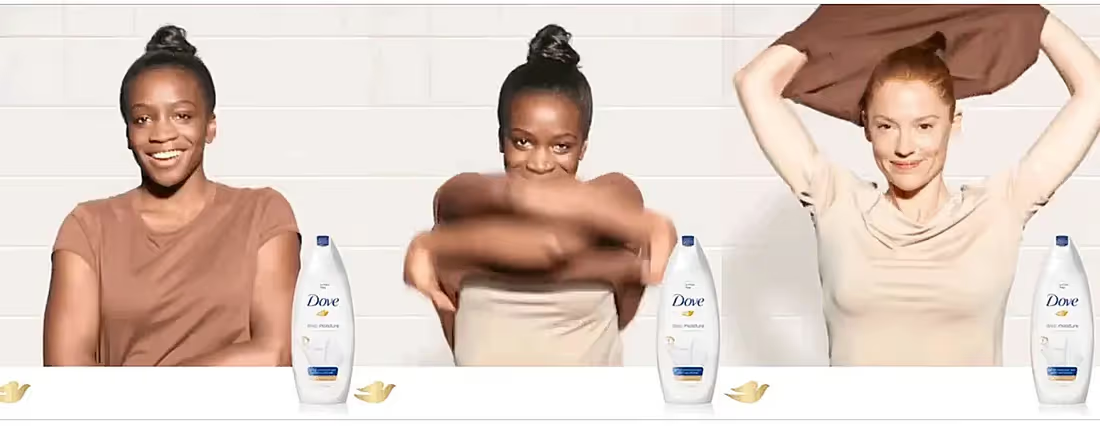
Take for instance one of Dove’s most infamous campaigns, which aimed to celebrate “inclusion” by showing a black woman transforming into a white woman. This was obviously seen as tone-deaf and racially insensitive. The misstep highlighted the risks of trying to represent subcultural identities without genuine understanding or diverse perspectives in development.
Another epic fail dates back to the 1990s when Panasonic’s Japanese branch launched a touchscreen PC named “The Woody” and marketed it with the slogan “Touch Woody — The Internet Pecker,” which, due to the slang interpretation of “pecker” in English, was a highly embarrassing and unintended double entendre.
It is true that even in the present day, beyond products, people are looking for proof that human weirdness, community connection, and authenticity still exists somewhere in the world.
But the most powerful brands don’t start with a product and then find a ritual to attach it to. They identify the ritual first. The thing people are already doing to make sense of their world, to express their identity, to connect with their tribe. Following this, they become part of that story.
Think about it: skateboarding existed long before skateboard brands. Coffee rituals existed before specialty coffee shops. Gaming communities existed before gaming gear companies. The brands that capitalised on these markets became the tools that helped these movements express themselves.
This is the difference between targeting a demographic and joining a revolution.
Subcultures don’t need brands. Brands need subcultures.
So if you’re serious about tapping into one, show up like you mean it.
Start small.
Build worlds, not campaigns.
Don’t just chase metrics but chase meaning. And whatever you do, don’t force it. The moment you fake it, you’re out.
Learn to Speak in Code
Now, before you start planning your movement, let’s talk about the delicate dance of actually pulling this off. Because here’s the thing about building a cult, you can’t exactly put up a billboard that says “Hey, weirdos! Come join our weird thing!”
Well, you could. But you’d probably alienate half your potential tribe while confusing the hell out of everyone else.
You need to figure out the art of winking at the right people. And even when the process is not audience first, you still need guard rails.
This is also where a lot of brands quietly veer off track. They treat this approach as a way to define their ideal customer, when in reality, it’s more useful as a filter to avoid attaching themselves to subcultures that don’t align with their product’s energy, relevance, or the life-stage of their users.
Step 1: Define Foundational Filters
- Think age bands: what generational preferences might you tap into, even indirectly?
- Think geographies: where are cultural shifts bubbling — regional and global?
- Think aspirational arcs: what kind of identity evolution are people navigating?
The beauty of this approach lies in its mathematical precision. Your subcultural audience gets the deeper meaning, the insider reference, the emotional connection that says “this brand gets my world.”
But this is not even scratching the surface.
Step 2: Data Mining & Social Listening (the intro was clearly a clickbait)
Now comes the detective work. You’re hunting for cultural undercurrents that are just starting to bubble up. You’re not looking for mainstream trends. The goal is to catch movements before they become movements, when they’re still authentic conversations rather than obvious marketing opportunities.
Key Platforms to Scan:
- Reddit: Dive into niche subreddits like r/Biohackers, r/IndianSkincareAddicts, r/MaleFashionAdvice. These communities are brutal with authenticity known to call out posers faster than you can say “brand partnership.”
- Telegram/Discord: Join public channels discussing wellness, aesthetics, lifestyle movements. This is where real conversations happen before they get sanitized for Instagram.
- Trend Forecasting Sites: WGSN, TrendHunter, The Future Laboratory (if you can access them). These are your cultural early warning systems.
- Google Trends: Run comparative year-over-year keyword volume analysis. Numbers don’t lie, but they also don’t tell the whole story.
- Instagram/TikTok: Observe niche creator communities and viral sub-niches. Look for the creators who aren’t trying to go viral, they’re usually onto something real.
- YouTube: Search for “rise of [x] subculture” documentaries or video essays. If someone’s making a 45-minute video essay about it, there might be cultural weight there.
- Media Coverage: Check for early but sparse references in mainstream outlets like NYT, GQ, Vogue. You want the whispers, not the headlines.
Signals to Look For:
- Community Growth: Is that Reddit group or Discord server actually growing, or just getting louder?
- Content Virality: Are creators talking about this getting better engagement than their usual content?
- Language Co-occurrence: New terms, aesthetics, or phrases being repeatedly associated with the movement?
- Crossover Appeal: Has the subculture been referenced (even briefly) by mainstream figures? That’s your early warning that it’s about to explode.
Step 3: Validate Cultural Trajectory
Not every underground movement is destined for mainstream recognition. Some are meant to stay underground and trying to commercialise them will destroy their authenticity.
Ask yourself:
- Is this showing year-on-year growth in public conversation, or is it just seasonal noise?
- Has there been a recent spike in creator participation or content viewership that feels sustainable?
- Are influential figures or micro-celebrities beginning to speak in the subculture’s voice naturally?
- Does it feel aspirational and forward-looking, or nostalgic and backward-facing?
- Is the movement building toward something, or mourning what’s been lost?
This helps you distinguish between a genuine resurgence (like analog photography’s comeback) and cultural irrelevance (sorry, emo-core fashion with its skinny jeans and gaudy makeup, but your time might have passed).
Step 4: Evaluate for Brand Integration Potential
Even if a subculture is growing and culturally significant, it might be completely wrong for your brand. And that’s okay, better to acknowledge the mismatch now than become a cautionary tale later.
Ask the hard questions:
- Can your brand’s visual language evolve to match this subculture without looking like a costume?
- Does the tone of voice, be it witty, intellectual, bold, quietly confident, actually align with what you can deliver?
- Are there existing products or rituals in the subculture that your brand could naturally plug into?
- Would influencers from this space organically use or advocate for what you’re selling?
- Can you host or participate in events, workshops, panels in this space without feeling like a corporate intruder?
- Could your packaging, formats, language, and even sonic identity reflect their vibe authentically?
If you’re answering no to most of these, move on. There are other subcultures out there, and forcing a fit never ends well.
Step 5: Prioritize Based on Strategic Weight
When multiple viable options emerge, it’s time to get strategic about your choices. Use these filters to separate the golden opportunities from the shiny distractions:
Priority Metrics:
- Depth of Brand Fit: How naturally does this subculture align with what your brand can offer credibly and creatively?
- Competitive Saturation: Is the space already crowded with brands trying to own it? More whitespace means better opportunity.
- Scale of Reach: What’s the realistic short-term and long-term potential audience size?
Use these filters ruthlessly to select your top 1–2 subcultures for deep exploration. Remember, it’s advisable to own one subculture completely than to half-heartedly participate in five.
Step 6: Design World-Building Framework
This is where strategy becomes creativity. Once you’ve selected your subculture, it’s time to build the brand world that will make you feel like a natural inhabitant rather than a tourist with a camera.
Map out every touchpoint:
- Visual Aesthetic: Typography that speaks their language, colors that feel native, textures and photography styles that resonate
- Sonic Cues: Sound design, curated playlists, voiceover tonality that matches their energy
- Content Pillars: Themes that make sense organically
- Packaging Cues: Materials, ergonomics, structure, typography that signals belonging
- Influencer Mapping: Creators across all follower sizes who are authentic voices in the space
- Event & Collaboration Strategy: Drops, IRL events, advisory boards, co-creations that amplify authenticity rather than announcing your arrival
This framework becomes your North Star for every future brand decision. When in doubt, check it against the subculture’s values.
Step 7: Test Integration Softly
Before you go all-in with a rebrand announcement and press release, test the waters. Subcultures have sensitive immune systems, they can reject foreign bodies quickly and brutally.
Start small and listen:
- Run content tests using the subculture’s language patterns on Instagram and TikTok
- Collaborate with 2–3 micro-creators to validate community response before scaling
- Drop limited-edition content or products that speak directly to the subculture and observe reception carefully
- Track follower overlap with known subculture nodes to measure authentic engagement
Use this feedback to refine your tone, language, or aesthetic before full rollout. Think of it as cultural user testing. The cost of getting it wrong is higher than just lost sales. It’s lost credibility, and in subcultures, credibility is the one currency that matters most.
So where does this leave us? Right back where we started, but with better tools.
The data-led branding industrial complex has trained us to believe that consumer behavior is predictable, that desire is quantifiable, that belonging can be optimized through better targeting parameters.
But meaning doesn’t emerge from metrics. It emerges from the messy, irrational, beautifully human need to find your people in a world that often feels designed to isolate us.
When Liquid Death turns hydration into rebellion, or Marine Serre transforms existential dread into high fashion, they’re building brands that provide the cultural infrastructure that helps people understand who they are. Their symbols and stories transform individual anxiety into collective identity. What they’re doing is subversive. They are making people feel less alone in the world.
This is why subculture-driven branding works. It acknowledges that people don’t want to be sold to. They want brands that function as cultural translators, helping them navigate the space between who they are and who they’re becoming.


Continue
Reading

Best Branding for Startups: Differentiation vs. Distinction
Most branding work for startups delivers a style guide. A style guide governs what a brand looks like. A signal system governs what a brand makes people feel, recall, and associate, at every touchpoint, over time, without being reminded. The difference between the two is the difference between a brand that is different and a brand that is unmistakable.


What Visual Identity Is Actually For (And What AI Cannot Replace)
The designer who cannot articulate the argument behind each element of a mark has not made a design decision. They have made a visual guess. AI generates visual guesses that look like design decisions. The difference is not immediately visible. That is exactly the problem.

Sustainable Packaging Is Brand Identity, Not Just Ethics
The brands that have built durable advantage through sustainable design share almost nothing in common, except this: the packaging choice was an expression of what the brand already believed about itself, not a response to what regulators or critics required.