How Brands Encode Trust Before They Say Anything
May 12, 2026





Contents
1. The 50-Millisecond Argument for Brand Identity
2. The Four Channels of Pre-Linguistic Brand Trust
3. Where Most Brand Identity Falls Short of Its Own Strategy
4. Your Brand Identity Is Already Making Its Case
5. Frequently Asked Questions
Pick up a business card from a stranger. In less than a second, before you have processed a single word, something has already happened. A verdict has been filed. Not consciously. Not about the font, exactly. A signal passed between their brand and your nervous system, and you either registered it as credible or you didn't.
That isn’t aesthetics. That is a brand identity argument, and your brand is making it, every time someone encounters it, whether it prepared for that moment or not.
This is the gap between brand identity and brand strategy that most founders never close before they commission visual work. Strategy is the argument you make about why your brand exists. Identity is the sensory system that makes that argument visible. But here's what the research reveals: the identity files its own trust case the moment someone encounters it, at a neurological level that language cannot reach and copy cannot override.
The 50-Millisecond Argument for Brand Identity
In 2006, researcher Gitte Lindgaard and her colleagues at Carleton University published a study that should be mandatory reading for anyone who has ever spent three months on a rebrand.
Visual appeal judgments form within 50 milliseconds of exposure.
Not 500. Not 5,000. Fifty. And when participants were given more time, the verdicts barely changed. The fast judgment was also the final one.
Don Norman's Visceral Level and the Pre-Conscious Read
Don Norman, in Emotional Design (Basic Books, 2004), calls this the visceral level: the pre-conscious, involuntary gut response to appearance. The brain isn't reading your brand at this stage. It is running a pattern match against years of cultural conditioning and evolutionary heuristics for competence, safety, and credibility. This is where trust is first produced or denied. The inputs are your typography, your colour, your spatial proportions. Not your copy.
Once the unconscious tags a brand as incoherent or amateurish, the copy is fighting a verdict that arrived before the headline loaded.
The Four Channels of Pre-Linguistic Brand Trust
There are four visual channels through which trust is transmitted before language begins. Each one is running a cultural argument your audience processes before they decide whether to keep reading.
Typography as Class Signal
Typography doesn't organise information. It makes an argument about what kind of institution you are.
Serif versus sans-serif is not a preference. It is cultural shorthand for tradition and authority versus modernity and accessibility, processed before reading begins. Monotype’s 2023 neuroscience research confirmed that font choice triggers distinct emotional responses by country and cultural context. As their Executive Creative Director Phil Garnham noted: “Everyone brings their own history and personal perceptions to a typeface.”
This is a dimension of how brands carry meaning without language — something we explore at length in our piece on semiotics for founders.
A fintech startup using a generic system font is not making a neutral choice. It is telling a trust story that undercuts its own product ambition.
I worked with a founder last year who had spent six months on their positioning and two days on their typeface. The positioning said rigorous and specialist. The font said startup template. No one said anything in the room, but the deck didn’t close.
Colour as Cultural Argument
Colour is not preference. It is a pre-loaded cultural meaning system.
Barthes, in “Rhetoric of the Image” (collected in Image, Music, Text, Fontana Press, 1977), described how visual signs carry a coded iconic message: a layer of culturally conditioned connotation that operates below conscious decoding. Blue doesn’t signal trust. Specific blues, in specific typographic contexts, at specific saturations, signal specific things. Most brands choose colour based on what they like. That is the equivalent of choosing a legal argument based on what sounds nice.
Cadbury’s purple demonstrates the discipline this requires. The specific shade — Pantone 2685C — is trademarked not as a legal manoeuvre but because it carries decades of connotation for luxury and generosity that an adjacent purple simply doesn’t. Swap it for a cooler, darker violet and the trust signal collapses. The brief changes without a word being rewritten.
We explore this in much more depth in our piece on why colour is never just a preference.
Proportion and Spatial Weight
A layout with arbitrary proportions reads as careless. Carelessness reads as unreliability.
A 2025 study in the European Journal of Neuroscience by Iosa, Lucia and Salera applied an ecological perception framework to aesthetics, arguing that human visual systems are calibrated to environmental regularities like symmetry and harmonic proportion because we have internalised them over evolutionary time. Proportional harmony doesn’t read as beautiful by accident. It reads as intentional. And intentionality is a trust signal before any claim is made.
For the full argument on how layout encodes trust, see our piece on why the grid is not neutral.
And where the first three channels operate at a distance, material quality closes the gap entirely.
Material Quality on Physical Surfaces
Weight, finish, and density register as character statements before the print is read. A thin card signals a thin business. A dense, uncoated stock files a different brief entirely.
Together, these four channels either cohere into a single trust argument or contradict each other into noise.
Where Most Brand Identity Falls Short of Its Own Strategy
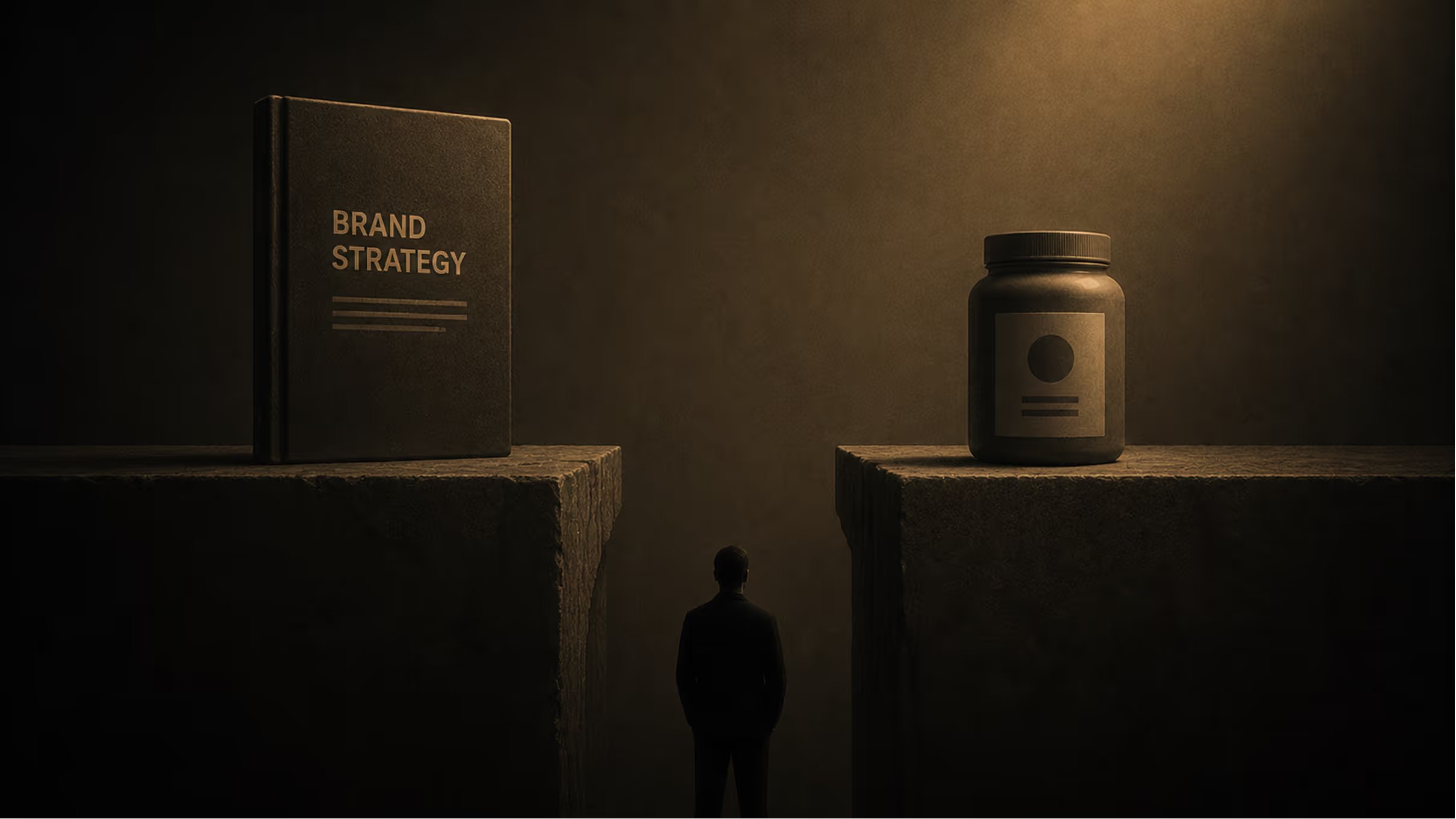
The gap between brand identity and brand strategy isn't a communication problem. It is a trust problem.
Most brands treat identity as decoration downstream of strategy — something to commission after the positioning is resolved. But the trust argument is made by the identity, not the strategy document. If the strategy says premium and precise, but the identity uses a generic free font, arbitrary proportions, and inconsistent weight, the brief is invisible. The identity is the only message that lands.
When the Identity Contradicts the Strategy
Gap discovered this in October 2010, when they replaced a logotype that had carried 24 years of visual equity with a Helvetica wordmark and a small gradient square. The new design wasn't objectively bad. It was incoherent relative to the trust signal customers had internalised over two decades. The backlash was immediate and overwhelming, and the rebrand was reversed within six days.
Gap hadn't changed its strategy. It had broken its trust argument.
Brand identity and brand strategy must be the same argument. One made in language. One made in form.
If that gap is open in your brand, our brand audit identifies exactly where identity and strategy diverge — and what it costs you.
Frequently Asked Questions
What is the difference between brand identity and brand strategy?
Brand strategy is the argument a brand makes about why it exists and who it serves: its positioning, its promise, and its persona. Brand identity is the sensory system that makes that argument visible. Strategy without identity is invisible. Identity without strategy is arbitrary. The confusion happens because most founders commission identity work before their strategy is resolved.
Can visual design really affect whether customers trust a brand?
Yes, and the mechanism is neurological, not metaphorical. Research by Lindgaard et al. (2006) demonstrated that credibility judgments form within 50 milliseconds of visual exposure, before conscious processing begins. If the visual signals are incoherent or incongruent with the brand's claimed position, that trust argument fails before a word is read.
What visual cues communicate trust most strongly?
Consistency signals intentionality. Proportional harmony signals craft. Typographic appropriateness signals cultural fit. Colour coherence signals strategic resolution. Of these, consistency across touchpoints may carry the most weight, because visual inconsistency reads as institutional unreliability.
Is brand identity more important than brand strategy?
Neither is prior to the other, but the sequencing matters. Strategy should precede identity: the visual system exists to make the strategic argument tangible. Brands that build identity before strategy produce beautiful work that makes the wrong argument. The goal is for identity and strategy to be indistinguishable, both telling the same story, one in language, one in form.
Your Brand Identity Is Already Making Its Case
That business card from the opening. Before you read the name on it, your nervous system had already returned its verdict.
The brand that made it either understood that moment and prepared for it, or it didn't. The fonts, the proportions, the weight of the paper, the colour of the ink: these had already filed their case. Not with your conscious mind. With the part of you that decides before reasoning begins.
Most brands are making that argument by default. And calling it a design choice.


Continue
Reading

Best Branding for Startups: Differentiation vs. Distinction
Most branding work for startups delivers a style guide. A style guide governs what a brand looks like. A signal system governs what a brand makes people feel, recall, and associate, at every touchpoint, over time, without being reminded. The difference between the two is the difference between a brand that is different and a brand that is unmistakable.


What Visual Identity Is Actually For (And What AI Cannot Replace)
The designer who cannot articulate the argument behind each element of a mark has not made a design decision. They have made a visual guess. AI generates visual guesses that look like design decisions. The difference is not immediately visible. That is exactly the problem.

Sustainable Packaging Is Brand Identity, Not Just Ethics
The brands that have built durable advantage through sustainable design share almost nothing in common, except this: the packaging choice was an expression of what the brand already believed about itself, not a response to what regulators or critics required.