AI Won't Kill Brand Design. It Will Expose Bad Thinking.
May 6, 2026





A founder signs up for Looka. Pays $65. Four minutes later, they have a logo, a colour palette, a brand guidelines PDF, and a set of social media templates. The whole thing looks credible. The typography is clean. The palette is coherent. It would pass without comment on a pitch deck.
Here's the thing. If nobody can tell the difference, you have to ask: what were studios selling?
This is the question that most of the branding industry is carefully not asking. Instead, the conversation has settled into something comfortable: AI is a tool, not a replacement. Human creativity cannot be replicated. The quality gap still exists. All of this is technically true. None of it is the point.
AI doesn't threaten great brand work. It threatens mediocre brand work. And mediocre brand work, it turns out, was always the majority of what was being sold. What founders are discovering is that an AI startup branding agency can now deliver a passable identity system in the time it takes to make a coffee. The execution layer, the layer where most mid-market studios built their fees, is gone.
The real casualty isn't design. It's the studios who never figured out what they were actually selling.
In This Piece
1. The Execution Layer Is Gone
2. What AI Actually Replicates (And It's More Than You Think)
3. The One Thing AI Cannot Do: Strategic Diagnosis
4. The Studios Already Obsolete
5. What Thinking-Led Studios Offer That Machines Don't
6. Frequently Asked Questions
7. The Brief That Changes Everything
The Execution Layer Is Gone: What AI Startup Branding Tools Actually Do
Let me be specific, because the argument only works if you're not underselling what these tools do.

A $65 Looka Premium subscription gives you: multiple logo variants, a full colour palette, a brand guidelines PDF, social media templates, and a business card design. Tailor Brands adds website building and branded merchandise. Adobe Firefly generates on-brand visual assets from prompts. Midjourney produces image directions that would have cost a day of a photographer's time a year ago.
These outputs are not bad. That's the uncomfortable part. They are technically competent. They satisfy a brief for a founder who doesn't know what they don't know, which is most founders.
The Nielsen Norman Group, not known for hyperbole, published an update in May 2025 noting that narrow-scope AI tools, the kind built to do one design task very well, had improved meaningfully. The quality gap between AI-generated work and professional execution is closing. Anyone building a business case on 'AI just isn't good enough yet' is standing on a shrinking island.
And there's a broader signal worth reading. A March 2026 analysis of the design industry found that design job postings rose by roughly 60 percent in 2025 compared to the year before, even as entry-level roles were collapsing. More jobs, fewer juniors. What that tells you is that AI isn't eliminating design. It's sorting it. The production floor has been automated. What remains is everything that required judgment.
What AI Startup Branding Really Replicates: And It's More Than Taste
Here's the uncomfortable section.

What AI replicates is trend-following aesthetics, category conventions, and pattern-matched visual languages from successful brands. The scandi-minimalist palette for DTC. The neo-brutalist grid for fintech. The hand-lettered warmth for artisan food. These aesthetic codes are legible, reproducible, and learnable by any model trained on Behance.
But here's what I actually found when I traced this properly. That is also exactly what most mediocre branding was doing.
A studio would look at what was working in the client's category. It would pull references. It would produce a moodboard of successful brands the client aspired to. Then it would design something that pattern-matched against those references and called it 'creative direction.' The client paid fifteen thousand pounds for a more expensive version of what they could have described to a model.
Elizabeth Goodspeed, writing in It's Nice That in 2024, argued that AI can't give you good taste. She's right, but only for a specific definition of taste. AI is very good at replicating the taste of a specific moment. The question is whether replicating the taste of the moment was ever what brand design was supposed to do.
The FRD Studio put it well: AI equalises the execution playing level. Which means if your studio was competing on execution, the floor just disappeared.
The Industry's Uncomfortable Mirror
The data is worth sitting with.
Between 2020 and 2025, IDEO, the company that popularised design thinking, saw its revenue fall from $300 million to $100 million. Headcount halved. IBM eliminated its Chief Design Officer position entirely. Entry-level designer hiring at Big Tech dropped 50 percent between 2019 and 2025, per analyst Roger Wong's research. These aren't AI displacement stories.
They're strategic relevance stories.
The studios and roles that lost ground were the ones that never articulated what their thinking was worth. When the pressure came, there was no argument to make.
The One Thing AI Cannot Do: Strategic Diagnosis for Brand Builders
This is the thesis in full, so let me be precise about what I mean.

Strategic diagnosis is not the same as strategy delivery. Strategy delivery is producing a positioning document, a visual language, a naming architecture. AI can assist with all of those. Strategic diagnosis is the specific act of identifying the core tension a brand must resolve. And that is irreducibly human.
The gap between what a company believes about itself and what the market actually experiences. The contradiction between a product's maturity and its visual language. The misalignment between the founder's identity and the customer's. These tensions aren't in the brief. They're what you find when you read past the brief.
AI optimises for pattern. A diagnosis identifies where the pattern breaks.
What Strategic Diagnosis Actually Means
Here's a concrete way to see the difference.
A brief asks: 'What should our brand look like?'
A diagnosis asks: 'Why does this brand feel unconvincing to the people who already use it?'
Marty Neumeier's The Brand Gap, which has been read by roughly 25 million people, makes a distinction between logic thinkers and magic thinkers, the analytical and the intuitive, and argues that a charismatic brand is one for which people believe there's no substitute. The book's central argument is that the gap between these two modes of thinking is where brand failure lives. AI can now execute on both sides of that gap. What it cannot do is identify which gap exists for a specific brand in a specific market at a specific moment.
Neumeier's later work, Zag, introduced the concept of Onlyness: 'Our [X] is the only [Y] that [Z].' It's a diagnostic question. Answering it requires genuine market knowledge, category intelligence, and an understanding of what competitors cannot credibly claim. A model can generate a sentence in that format. It cannot determine whether the sentence is true.
Diagnosis Requires Reading What Isn't in the Brief
Wally Olins, the co-founder of Wolff Olins and one of the most experienced practitioners of corporate identity, spent much of his career on what he called the 'core idea': the central organising principle that everything downstream of a brand (the name, the logo, the tone, the architecture) flows from. His argument, developed across The Brand Handbook and On Brand, was that this core idea is not given by the client. It's uncovered through them.
That uncovering requires reading the organisation anthropologically. The founder's psychology. The things the team avoids saying. The product features they're most proud of that nobody outside cares about. The customer behaviour that contradicts the internal assumptions. This is the kind of contextual intelligence that a large language model approximates but cannot ground in the specific reality of a single company.
A brief is what a client believes about their brand. A diagnosis is what you find when you look past the belief.
The AI Startup Branding Studios That Are Already Obsolete
Obsolescence here doesn't mean studios using AI. It means studios whose entire value proposition was delivering styled outputs within category conventions.
If your pitch is 'we make beautiful brands,' that is already commoditised.
If your pitch is 'we find the strategic problem your brand isn't solving,' that is not.
Here are the signals that a studio's value was always in execution, not thinking:
• The portfolio leads the pitch, with no strategic rationale for any of the work shown
• The proposal's first deliverable is a logo concept, not a positioning or strategy document
• Pricing is built around hours of visual production rather than strategic output
• The timeline starts at the 'design phase,' with no prior diagnostic stage
• The studio talks about brand 'aesthetics' and 'look and feel' before it talks about market position
• The client brief goes directly into execution without a discovery conversation
Read that list and ask yourself which kind of studio AI has just undercut completely.
The distinction, made plain:
What Thinking-Led AI Startup Branding Agencies Offer That Machines Don't
The affirmative case is specific, so let me make it specifically.
Thinking-led studios offer a diagnosis before a direction. A strategic position before a visual language. A named tension the brand must resolve before a single asset is produced. The value is in the question before the answer.
The Strategic Brief as the Irreplaceable Deliverable
The single most valuable output from any serious branding engagement is not the logo. It's the strategic brief that precedes it.
The brief names the tension. The logo resolves it visually. AI can execute the resolution. It cannot author the brief.
Tara Nadella, a product manager at Figma, said something sharp at Schema 2025 that's worth applying here: 'Speed without direction leads to divergence.' She was talking about design systems, but it lands just as hard on brand strategy. Founders who use AI to ship a visual identity fast, without strategic grounding, are accelerating in the wrong direction. They have a logo. They don't have a position.
What a Diagnosis Produces That a Prompt Never Will
Neumeier's Brand Flip introduced the Brand Commitment Matrix: a set of diagnostic questions about customer identity, aims, and values that a strategist must answer from real context. The questions look simple. What are your customers trying to become? What do they believe that your competitors' customers don't? What would they lose if your brand disappeared?
These questions cannot be answered by prompting a model. They require someone who has sat with the founder, read the category, talked to the customers, and formed a judgment that is specific to this business at this moment.
What a strategic diagnosis produces that no prompt will: a named market tension. A recommendation about what not to say. A decision about which customer belief to challenge and which to confirm. These outputs require judgment, not pattern matching.
The thinking that precedes brand design is more like a diagnosis than a creative brief. And we don't automate diagnosis. We automate the treatment that follows it. Studios whose value was always in thinking aren’t going anywhere. The ones who were in the execution business are already obsolete. They just haven’t realised it yet. (Our position on AI-generated identity work goes further on this — particularly on where AI collaboration serves a brand’s long-term interests and where it doesn’t.)
Frequently Asked Questions About AI and Brand Strategy
Can an AI startup branding agency replace a human brand strategist?
No, but it can replace execution-only designers. The distinction is between brand production, which AI handles well, and brand diagnosis, which requires a human. The former is making the brand look right. The latter is identifying the core tension it needs to resolve. AI can now do the former. The latter remains irreducibly human, though the boundary is moving.
What does a brand strategist do that AI tools cannot?
Identify the core tension a brand must resolve. Read the political and cultural context of an organisation. Make recommendations about what to stop saying as well as what to start. Neumeier's Onlyness test, 'our [X] is the only [Y] that [Z],' is a useful example: answering it requires genuine market intelligence that a model can format but cannot verify. A prompt produces a sentence. A strategist produces a position.
Are AI branding tools like Looka good for startups?
Yes, for founders who have already done their strategic thinking. AI tools execute well once direction is set. The mistake is reaching for them before positioning is resolved. A founder who knows exactly who they are, who they're for, and what they stand against can use Looka effectively. Most founders at the point of brand creation don't have that clarity yet. That's the work that needs doing first.
How do I know if my branding agency is strategic or just executional?
Ask whether the process starts with a diagnostic phase. If the first deliverable in the proposal is a logo concept rather than a positioning or strategy document, the studio's value is in production, not thinking. That's the studio AI has already undercut. A thinking-led engagement starts with a diagnosis of what the brand needs to resolve, not a draft of what it could look like.
The Brief That Changes Everything
Come back to that founder with the $65 logo kit.
The problem was never that they had a bad logo. The problem was that nobody gave them a position.
The $65 kit gave them a visual. It gave them colour and type and a mark that looks like a brand. What it didn't give them was an answer to the actual question: what does this brand believe that its competitors won't say? Who is it for that nobody else is genuinely building for? What tension does it resolve that the category has been ignoring?
Those questions require a person who has looked at the business and the market and made a judgment. That is not a prompt. That is a diagnosis.
The studios that will survive AI are the ones who were never in the logo business. They were in the thinking business. They just didn't always say so.
AI didn't create the problem.
It just made the problem impossible to ignore.


Continue
Reading

Best Branding for Startups: Differentiation vs. Distinction
Most branding work for startups delivers a style guide. A style guide governs what a brand looks like. A signal system governs what a brand makes people feel, recall, and associate, at every touchpoint, over time, without being reminded. The difference between the two is the difference between a brand that is different and a brand that is unmistakable.
What Visual Identity Is Actually For (And What AI Cannot Replace)
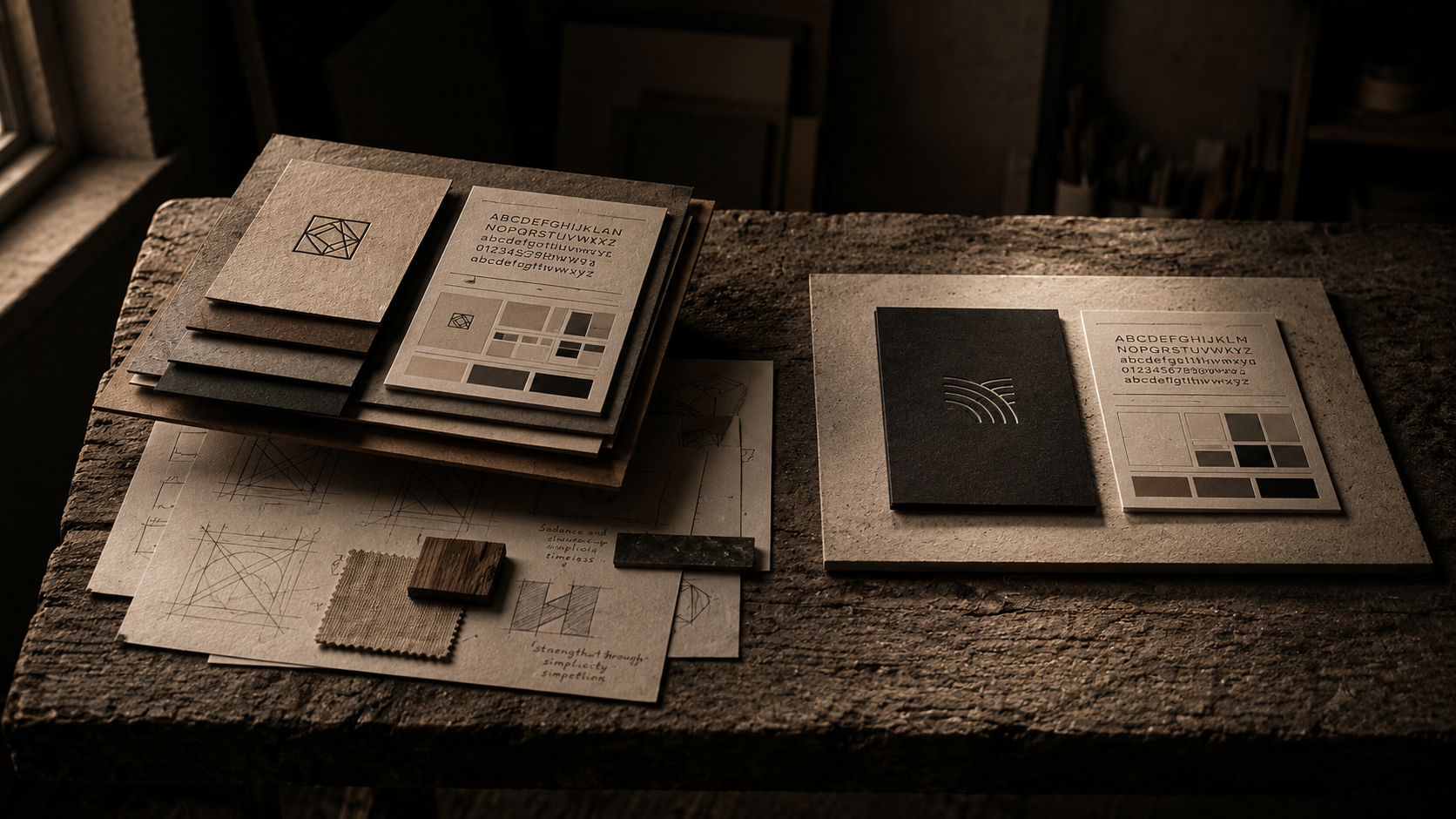
The designer who cannot articulate the argument behind each element of a mark has not made a design decision. They have made a visual guess. AI generates visual guesses that look like design decisions. The difference is not immediately visible. That is exactly the problem.

Sustainable Packaging Is Brand Identity, Not Just Ethics
The brands that have built durable advantage through sustainable design share almost nothing in common, except this: the packaging choice was an expression of what the brand already believed about itself, not a response to what regulators or critics required.