What Visual Identity Is Actually For (And What AI Cannot Replace)
August 26, 2026





Two presentations are on the table.
One took three weeks. A senior designer ran twelve rounds of exploration before arriving at a mark she could defend in the room. She knows why the typeface signals authority without stiffness. She knows why the palette creates distance from the category without alienating the buyer. She has, in the language of the brief, an argument.
The other took an afternoon. A strategist with a sharp prompt and a good eye ran four tools, curated forty outputs down to three, refined the strongest, and brought it to the table. It looks credible. Honestly? It looks more than credible.
We are an AI startup branding agency. This is the scenario we are navigating.
They are on the table together now. The question is not which is better. The question is: what are we obligated to say about which is which?
We have been asked, as an AI startup branding agency, whether we use AI in visual identity work. The answer requires more than a yes or a no. This piece is our attempt at a genuine one.
Four questions drive what follows: who made it // should clients know // what is visual identity actually for // and where do we draw lines. This is not a policy document. It is a studio thinking out loud about what we actually believe, having used these tools and watched the market respond to them.
In this piece:
1. What AI Has Already Changed in Brand Identity Work
2. The Authorship Question in AI-Powered Visual Identity
3. On Disclosure: Our Practice in an AI Startup Branding Studio
4. What Visual Identity Is Actually For (And What AI Cannot Replace)
5. Where an AI Startup Branding Agency Draws Its Lines
6. Frequently Asked Questions
7. The Only Thing That Changes the Answer
What AI Has Already Changed in Brand Identity Work
Let me be honest with you about something most studios will not say.
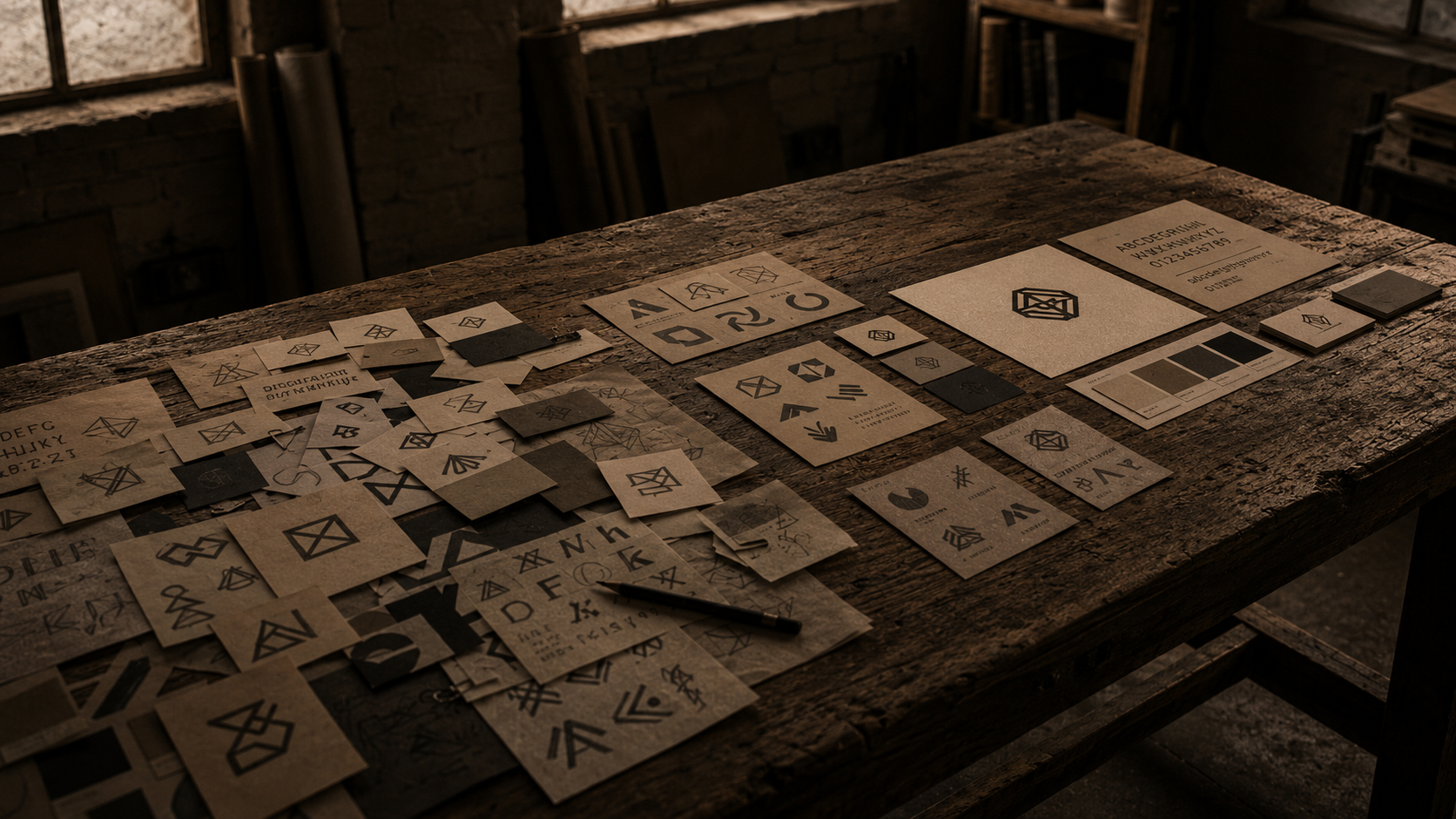
The tools are good. Not good the way people mean when they are being polite about something they secretly find threatening. Actually good. Midjourney generates logotype concepts with visual coherence. Adobe Firefly produces colour explorations that a junior designer would be proud to present. Looka, Brandmark, Canva AI: these are not toys. The AI logo generator market reached $0.48 billion in 2024 and is projected to hit $1.35 billion by 2029, at a 22.7% compound annual growth rate. The clients using these tools are not making a mistake they do not know about. Some of them are getting exactly what they paid for.
The mistake is assuming that what they paid for is the same as what a brand studio delivers.
What AI Tools Can Now Generate
Looka describes its product as having 'a digital brand designer by your side.' It is not wrong. Brandmark evaluates balance, colour contrast, and scalability. Design.com considers industry type, target keywords, and colour psychology before generating options. These platforms produce logotypes, colour palettes, typographic systems, brand guideline documents. The visual output is often technically credible. A founder with a clear brief and a good eye can produce something that would pass a basic visual quality check in forty-five minutes.
That is not an accusation. It is the context.
The design industry's instinct has been to dismiss these tools as lesser. That instinct is both understandable and strategically wrong. Dismissing the output does not address the question the output raises: if a tool can generate something that looks like a brand identity, what is it that a brand studio is actually selling?
Why the Speed Argument Is Incomplete
Here is the problem with fast.
Fast feels like enough. A founder who has been staring at a blank Figma file for three months sees a credible mark in forty-five minutes and concludes: solved. The mark passes the 200ms visual credibility test. It looks like a brand. It has a palette and a typeface and a clear enough form that it can go on a website and a business card without embarrassing anyone.
The competitive differentiation test is different. That test happens in the room where the brand sits next to its competitors, and where a founder is asked: why would someone choose you over them, and how does your identity communicate that? AI tools generate isolated assets. They do not generate systems with intentional structure, and they cannot answer the competitive question because the competitive question was never part of the prompt.
Marty Neumeier, in The Brand Gap, makes a distinction that matters here. A brand symbol is what you see. Brand meaning is what it does. The speed argument collapses this gap by treating the former as evidence of the latter.
It is not.
The Authorship Question in AI-Powered Visual Identity
This is where I want to slow down, because the instinct to give a clean answer is exactly the wrong move.
If a designer writes a precise, culturally-situated, strategically-argued brief, runs it through Midjourney, generates forty options, curates three, refines the strongest into a final mark, and delivers it to a client: who made the mark?
The honest answer is: it is complicated. And the complication is worth naming rather than papering over with a confident claim in either direction.
When a Prompt Is a Creative Act
Paul Rand, in 'The Politics of Design' (1985), defined design as a problem-solving activity that provides a means of clarifying, synthesising, and dramatising a word, a picture, a product, or an event. The definition is upstream of the tool. Design, in this account, is the thinking that precedes the making.
Rand also said something more direct: 'Designers should be as rewarded for thinking when they don't draw as when they do.'
What this suggests is that a strategist who writes a precise prompt is doing something more like design than a designer who generates without thinking. The prompt that produces useful output requires the same upstream work as the brief that produces useful design: an understanding of the audience, the competitive context, the cultural moment, and what the brand needs to argue visually. That thinking is not eliminated by AI. It is what determines whether the AI produces something worth using.
The failure mode, though, is thinking you are designing when you are actually selecting. Selecting from forty options without being able to articulate a strategic reason for any particular choice is not design. It is pattern recognition with professional dressing. Roland Barthes argued, in 'The Death of the Author' (1967), that authorship is a retrospective construct rather than a fixed act of making. The point, adapted: the brief that precedes the generation is where the author's intelligence lives. Without that intelligence, the author of the output is not the studio. It is the prompt.
Curator vs. Creator: A Real Distinction
When a designer picks from AI-generated options, they are acting as curator. Curation is a genuine competency. It requires taste, cultural fluency, and strategic alignment. The best curators in any field are not passive. They are making arguments with their selections.
But curation is not the same as creation, and conflating them is where the ethical problem starts.
The test we use internally is simple: can the designer defend every element of the chosen option on strategic grounds, not on aesthetic preference? Not 'I like this mark' but 'this mark works because it creates distance from the category convention, communicates permanence to the target buyer, and scales to the brand's second product without losing legibility.'
If that case can be made, the curation was meaningful. If it cannot, what happened was guessing.
Margaret Boden's work on creativity is useful here. In The Creative Mind (Routledge, 2004), she identifies three forms of creativity: combinational, exploratory, and transformational. Combinational creativity combines known elements in new ways. Transformational creativity rewrites the rules of the conceptual space itself. AI is good at the first. Competent at the second. It cannot do the third.
Brand differentiation is a transformational problem. It requires not a new combination of existing visual vocabulary but a genuinely new position in the cultural space the brand occupies. That work is upstream of any tool.
The same argument applies to copy rather than marks: the question of brand voice in the age of LLMs runs through the same logic, and we pick it up there.
On Disclosure: Our Practice in an AI Startup Branding Studio
We will say this plainly.
If AI-generated elements appear in any final deliverable we produce for a client, the client is told before the final presentation. Not in a footnote. In the room, before the work is presented.
This is our practice. We are stating it publicly because the industry's default is the opposite. A 2023 study by SOCi found that while 65% of companies had integrated AI into their tech stacks, over half of the marketers surveyed expressed concern about disclosing this to their customers. That hesitation is the problem. The hesitation is itself a form of bad faith, and we want to be in the position of having said so.
What Counts as Disclosure (And What Does Not)
Disclosure is triggered when: AI-generated elements appear in the final identity system. AI-generated copy appears in the final brand voice document. AI-generated imagery appears in the final brand photography direction.
Disclosure is not triggered when: AI was used to generate options that were rejected. AI accelerated internal research or copy drafting that the writer then completely rewrote. Standard design tools (Adobe, Figma) used AI-assist features in the ordinary course of design workflow.
The test is simple: does the AI output appear directly in what the client purchased? If yes, the client knows before the work is presented.
AIGA, the leading professional body for graphic design, has acknowledged that AI is 'fundamentally reshaping our profession bringing both opportunity and disruption.' No specific disclosure framework has been formalised as of writing. That gap is not unusual; professional bodies typically follow practice rather than lead it. Our disclosure practice is our contribution to what that framework might eventually look like.
Why Transparency Does Not Weaken the Work
The assumption behind non-disclosure is that clients will trust the output less if they know the process. This assumption is worth examining carefully, because it contains its own critique.
If the strategic argument is good, disclosure strengthens it. The client who understands that AI generated forty typographic explorations and a designer curated the strongest on the basis of a specific competitive rationale understands what they are paying for. They are paying for the rationale, not the generation. Disclosure makes that clear.
The Coca-Cola 2024 AI Christmas campaign is instructive here. The ad, produced with multiple AI studios including Secret Level and Silverside AI, was widely described as soulless and lacking the emotional depth of the 1995 original it was replicating. The backlash was not because AI was used. It was because the output felt engineered rather than considered, and because the company's response to criticism was to defend the tool rather than the thinking. The lesson is not 'do not use AI.' The lesson is: if the strategic and emotional argument is not there, the tool becomes visible. And visible AI without visible thinking is the transparency problem, not the use of the tool.
Brands that deploy AI without a clear account of the reasoning behind it are particularly vulnerable to charges of inauthenticity, as Fast Company noted in its analysis of the pattern of AI marketing failures in 2025-2026. Transparency, in this reading, is commercially intelligent, not merely ethical.
If you want to understand how this works in an actual engagement, our process page walks through where AI enters and where it does not.
What Visual Identity Is Actually For (And What AI Cannot Replace)

Here is the essay's actual argument.
Visual identity is not aesthetics. It is a strategic argument made visible.
Every element of a mark is a position. The typeface argues something about register, class, and cultural reference. Does this brand belong to the territory of permanence (serif, historical weight) or agility (geometric sans, Swiss rationalism)? The colour creates a competitive argument: does this palette place the brand within the category convention or against it? The mark's weight and geometry signal something about the relationship between the brand and its buyer. Heavy implies authority. Light implies accessibility. Fine line implies craft.
These are not aesthetic choices. They are strategic claims.
Paul Rand put it most directly in Thoughts on Design (1947): 'In essence, it is not what it looks like but what it does that defines a symbol.'
Wally Olins, who spent his career arguing that brand identity was the physical expression of business strategy, wrote in Corporate Identity (1989): 'Identity is the tangible manifestation of the personality of the organisation.' In The New Guide to Identity (1995), he extended this: 'Corporate identity is a way of expressing a company's ethos, aims, and values: the business in shorthand.'
Both definitions are structural, not aesthetic. Identity, in this account, is compressed strategic argument. The mark is not decoration. It is a claim.
Visual Identity as Strategic Argument
The designer who cannot articulate the argument behind each element of a mark has not made a design decision. They have made a visual guess.
AI generates visual guesses that look like design decisions. The difference is not immediately visible. That is exactly the problem.
A Looka-generated mark can pass a visual quality test in the same room as a senior designer's mark. Both are technically credible. The difference reveals itself when the founder is in a competitive review, or when the brand needs to scale from a business card to a billboard, or when a second product launches and needs to live within the system, or when a competitor enters the category with a mark that is eerily similar because both were generated from the same training data. The visual guess holds until it breaks. The strategic argument holds because it was designed to.
What AI Optimises For vs. What Brand Strategy Requires
AI optimises for visual coherence, stylistic plausibility, and aesthetic consistency within the training data. These are real values. They are not sufficient.
Brand strategy requires: cultural positioning (where does this brand sit relative to competing cultural territories?), audience resonance (does this mark do something specific for the person it needs to move?), and competitive differentiation (does this mark create distance no competitor can claim?). These are not visual problems. They cannot be answered by a tool that has no knowledge of the specific competitive context and no stake in the outcome.
This is where Boden's framework lands with precision. AI's ceiling is combinational creativity: the sophisticated recombination of existing visual vocabulary. Brand differentiation is a transformational problem: it requires a genuinely new position in a cultural space, not a new combination of elements within the existing one. The distance between these two things is the distance between looking like a brand and being one.
This is precisely what the piece on why AI won't kill brand design, but will expose bad thinking, explores from a different angle. The tool reveals the presence or absence of strategic intelligence. It does not replace it.
Where an AI Startup Branding Agency Draws Its Lines
Positions should be stated plainly. Here are ours.
Six positions. Each one protects something specific.
● AI does not generate final logo marks at Izart. The mark is always drawn by a designer, with a brief that has been argued and defended before the designer opens a tool.
● AI can generate pattern, texture, and colour explorations in early-stage development. None of these are final without designer selection, testing across contexts, and strategic review against the brief.
● AI is used freely for copywriting ideation and structural drafts. It does not produce final brand voice / voice is written by a writer, edited to a brief, and reviewed by a strategist.
● Any AI-generated element appearing in a final deliverable is disclosed to the client before the final presentation.
● The brand brief is written before AI is involved in any way. Strategy is not prompted. It is argued.
● We do not use AI to manufacture visual diversity in brand presentations. When a brand requires diverse visual representation, we brief and commission it from real human creators.
Levi's drew significant backlash in 2023 when it planned to expand representation by using AI-generated diverse models rather than booking real models with diverse backgrounds. They reversed the decision. The problem was not the AI. It was the substitution of synthetic representation for genuine inclusion. That substitution is an ethical line, not a creative one, and we hold it.
What These Lines Protect (And What We Are Still Working Out)
Each line above protects something specific. The mark line protects the integrity of what the client is buying. The brief-first line protects the quality of the strategic argument. The disclosure line protects the honesty of the relationship. The no-synthetic-diversity line protects against a failure mode that is both ethically wrong and commercially dangerous.
What we are still working out: AI in motion design. AI in illustration system development. AI in photography direction briefs. These are open questions at the time of writing, and we want to say so plainly rather than claim a certainty we do not have.
These are positions, not policies. Positions are open to argument. Policies are not.
In our piece on AI as creative collaborator, we go further into how these positions play out inside an actual engagement // which tools, at which stage, with which oversight.
Frequently Asked Questions
Does using AI make a branding agency less credible?
Not by itself. Credibility comes from the quality of the strategic thinking and the honesty of the process, not from which tools were used. An agency that uses AI transparently, discloses it clearly, and can defend every decision on strategic grounds is more credible than one that uses only manual tools but cannot explain the argument behind any of them // the failure of credibility is in the absence of the argument, not the presence of the tool.
How do I know if my branding agency is using AI in my project?
Ask directly. A good agency will tell you clearly: which tools, at which stage, and whether any AI-generated elements appear in the deliverable you are buying. If the agency hedges or deflects, that tells you something. Disclosure should be offered without prompting. If you have to extract it, the transparency relationship is already broken before the work begins.
What is the difference between AI-generated and AI-assisted brand design?
AI-generated means the visual elements were produced by AI and appear, directly or with light refinement, in the final work. AI-assisted means a human designer used AI tools in some part of their process (exploration, ideation, workflow efficiency) but made all final decisions themselves. The distinction matters: it is what you are paying for.
Should I hire an AI startup branding agency that uses AI tools?
The question is not whether they use AI. It is whether they have a clear position on it. An agency that has thought carefully about where AI helps and where it does not is more valuable than one that either refuses it entirely or delegates to it without scrutiny. Ask for their position, not just their portfolio.
The Only Thing That Changes the Answer
The two presentations are still on the table.
I have thought about this scenario often since the tools became good enough to make it real. And here is what I keep coming back to: the mark that took three weeks can be defended, element by element, against the brief that preceded it. The designer knows why every decision was made. She can articulate the argument. She can be wrong, and the argument can be challenged, and the revision will be better for the challenge.
The mark that took an afternoon might be equally good as a visual object. It might even be better.
But if the strategist who curated it cannot make the same case, without reaching for what the tool suggested, then the client does not actually know what they bought. They have a mark without an argument.
And a brand without an argument is just a logo.
AI produces surfaces. The argument behind the surface is still a human obligation.
Until that changes, and perhaps even then, the studio's job is to know the difference.
And to say so.


Continue
Reading

Best Branding for Startups: Differentiation vs. Distinction
Most branding work for startups delivers a style guide. A style guide governs what a brand looks like. A signal system governs what a brand makes people feel, recall, and associate, at every touchpoint, over time, without being reminded. The difference between the two is the difference between a brand that is different and a brand that is unmistakable.
What Visual Identity Is Actually For (And What AI Cannot Replace)
The designer who cannot articulate the argument behind each element of a mark has not made a design decision. They have made a visual guess. AI generates visual guesses that look like design decisions. The difference is not immediately visible. That is exactly the problem.

Sustainable Packaging Is Brand Identity, Not Just Ethics
The brands that have built durable advantage through sustainable design share almost nothing in common, except this: the packaging choice was an expression of what the brand already believed about itself, not a response to what regulators or critics required.