Scarcity Was Never the Product: Brand Strategy for AI Companies
July 1, 2026





In 1993, a young man named Tomoaki Nagao was working out of a small shop in Tokyo’s Harajuku district. He went by Nigo. He could afford to make 50 T-shirts a week.
He sold 25. He gave the other 25 away.
Not to customers. To the artists and musicians and stylists whose desire other people would copy. The tastemakers who moved through Harajuku and made things feel worth wanting.
This wasn’t generosity. It wasn’t even strategy. It was a budget constraint that accidentally discovered something most brand builders spend their entire careers missing. It would become the foundational logic behind brand strategy for AI companies, fashion brands, and technology platforms alike.
Five years later, Nigo had 40 wholesale accounts across Japan. He cancelled all of them. Every contract, gone. He concentrated everything on a single flagship store in Shibuya.
Single-store sales matched what nationwide distribution had produced.
That moment is the beginning of this argument. And the reason it matters for brand strategy for AI companies just as much as it matters for streetwear is not about aesthetics. It's about structure. Restricting access didn't suppress demand. It clarified it.
The brand was A Bathing Ape. And the scarcity was never the supply constraint. It was the strategy.
Table of Contents
1. How the Drop Model Became Brand Strategy
2. The Psychological Engine: Why We Want What Others Want
3. Community as the Real Gatekeeping Mechanism
4. Why the Resale Market Is a Brand Signal, Not an Aftermarket
5. What Killed Supreme: Scarcity and Growth Are Oppositional
6. Brand Strategy for AI Companies: The Streetwear Playbook Decoded
7. Scarcity That Sticks vs. Scarcity That Tricks
8. Frequently Asked Questions
9. Before You Optimize for Distribution
How the Drop Model Became Brand Strategy
The conventional account of streetwear's rise is about youth culture, subversion, and the collision of hip-hop with skateboarding. All of that is true, and all of it is beside the point.
The more useful account is simpler: a group of brands discovered, through financial necessity and happy accident, that scarcity is not a supplement to a demand-creation strategy. It is the complete architecture of one.
The Accident That Became Architecture (BAPE, 1993-1998)
BAPE's early mechanics were forced on Nigo by circumstance. He produced only what he could afford to produce. He seeded the supply he couldn't sell into the hands of people whose taste others trusted. The tastemakers who moved through Harajuku and made things feel worth wanting.
When he made the audacious 1998 decision to cancel 40 wholesale contracts and consolidate to one Shibuya store, he wasn't executing a plan. He was betting that concentrated desire beats distributed availability.
He was right. As documented across the brand's history: the fundamental formula of streetwear was born, i.e. noise, scarcity and public spectacle.
Crucially, a 2026 CNN interview confirmed that none of this was masterminded. Nigo simply 'wanted to wear things that were different to everyone else.' The scarcity was aesthetic instinct before it was brand logic.
Which is, in retrospect, exactly why it worked.
Supreme's Thursday Drop as Ritual Architecture
Supreme formalized what BAPE discovered by accident.
The weekly 11am Thursday drop is now retail history. But what it built wasn't loyalty or even urgency. It built ritual. Customers queued without knowing what would be available. Products disappeared permanently once they sold out. Supreme's website traffic spiked by as much as 17,000% on drop mornings.
Adam Alter, a marketing professor at NYU Stern, described the mechanism precisely: 'If you want to create a scarcity frenzy, and your brand has a strong following, all you need to do is release a large number of different products, but very few of each one.'
What Alter's formulation doesn't quite capture is the stranger half of the insight. Supreme famously sold branded crowbars, metro tickets, toothpaste. These items resold at premium on eBay. Not because the product was exceptional. Because what the product conferred was proof of membership. Proof that you were there.
The object was almost irrelevant. It always was.
Corteiz and the Second-Generation Playbook
Corteiz, the London streetwear brand founded by someone known only as Clint, demonstrates the playbook in its current maturity.
Private Instagram. Password-gated website. Cryptic tease posts. Zero PR agency. No traditional advertising spend. In January 2023, Corteiz staged the 'Da Great Bolo Exchange' in a West London car park: fans traded North Face and Moncler jackets for an unreleased Corteiz puffer. The haul, worth 16,000 pounds, was donated to charity. The event was framed as modern day performance art. Not a single paid placement was involved.
The Growthcurve analysis of CRTZ captured the mechanism cleanly: 'A password drop feels like an invite, a queue feels like membership, and a collab feels like the culture recognising you rather than a media plan buying you.'
CRTZ didn't invent anything. It proved the principles outlive any single brand.
The Psychological Engine: Why We Want What Others Want

Here's the thing the case studies keep illustrating but rarely name.
Scarcity doesn't create desire. It amplifies desire that was already social.
To understand the distinction properly, you need Rene Girard.
Girard and the Triangular Structure of Want
Girard was a French social scientist who spent his career studying desire. His central insight, first articulated in 'Deceit, Desire and the Novel' (1961), is that human desire is not autonomous. We don't want what we want. We want what others want.
Desire is triangular: there is the subject, the object, and the model whose desire the subject is imitating. The queue outside a Supreme store isn't 400 people who independently decided they want a box logo hoodie. It's 400 people whose desire is being generated and amplified by each other's presence.
The object is almost incidental. Which is why Supreme could sell branded bricks at premium.
Luke Burgis, in 'Wanting: The Power of Mimetic Desire in Everyday Life' (St. Martin's Press, 2021), brought Girard's framework into business language: 'Models are people or things that show us what is worth wanting.' And: 'Mimetic desire operates in the dark. Those who can see in the dark take full advantage.'
Scarcity makes desire visible. The queue is not evidence of demand. The queue manufactures demand.
The Queue as Manufactured Social Proof
Every person who sees 400 people waiting outside a store receives a single signal: this object is desired. Their desire for that object is then conditioned by that signal, not by any intrinsic property of what's being sold.
This is why the mechanic translates perfectly into digital contexts. A tweet announcing a 180,000-person waitlist performs exactly the same function as the physical queue outside a Supreme store. You see others wanting it. You want it.
This is also why Supreme could sell branded bricks. The object never had anything to do with it.
Community as the Real Gatekeeping Mechanism
The drop is the visible mechanism. Community is the actual moat.
Scarcity isn't primarily about restricting access to a product. It's about controlling membership in a community whose desire signals social meaning to everyone outside it.
The International Stussy Tribe as the First Influencer Network
Before BAPE, there was Stussy.
Shawn Stussy didn't just restrict supply. He assembled the 'International Stussy Tribe': a loose collective of tastemakers across New York, Tokyo, London, and LA who wore and co-signed the brand. Two decades before Instagram existed.
The desire these tastemakers modeled cascaded downward. BAPE then built on this same infrastructure. As Highsnobiety documented, BAPE spread as 'a best-kept secret in closed circles abroad. Someone's friend would go to Japan, bring back some clothes and a few magazines, and the hype would slowly spread through word of mouth alone.'
This is demand engineering in its most deliberate form: choose the models carefully, make them visible, and let desire propagate.
The Private Instagram Is Not a Restriction. It's an Invitation.
Corteiz's private Instagram is widely described as a mystery tactic. It isn't. It's a community architecture decision.
Following the account feels like gaining insider access. The password-gated website turns buying into a test of devotion. You're not purchasing a hoodie. You're proving you're in the know.
And being in the know, not the hoodie itself, is the actual product.
The implication for brand builders is direct: your access mechanism is a brand statement. The ease or difficulty of getting in communicates what kind of brand you are before anyone has engaged with what you sell.
Why the Resale Market Is a Brand Signal, Not an Aftermarket

The resale market is typically treated as something that emerges after a brand succeeds. This gets the causality exactly wrong.
The resale market is the brand strategy proving itself.
StockX and the Financialization of Cultural Desire
StockX was founded in 2015 on an explicit metaphor: sneakers as stocks. The bid/ask model, price history charts, volatility indicators. None of this was gimmick. It was structurally correct.
These objects behave like financial instruments because they share the same defining property: their value is a function of collective belief, not intrinsic utility. A Supreme box logo hoodie is worth $500 on StockX and $50 at retail not because the cotton changed. Because the desire did.
StockX CEO Greg Schwartz articulated the market logic in January 2026: 'The brands that will win are those that understand scarcity, storytelling, and community, not just scale.'
The $30 billion projected sneaker resale market by 2030 isn't a secondary market. It's the primary evidence that the brand strategy worked.
And the inverse is confirmed in the data. Supreme fell 3% year-over-year on StockX in 2024. BAPE fell 7%. Both brands had loosened supply discipline. The market responded immediately.
What Killed Supreme: Scarcity and Growth Are Oppositional
In November 2020, VF Corporation acquired Supreme for $2.1 billion. By fiscal 2023, VF Corp had taken a $735 million impairment charge against the brand. Revenue had dipped 7% year-over-year to $523 million.
The VF Corp press release cited 'limited synergies' with Supreme's other brands: The North Face, Vans, Timberland. That phrase, inadvertently, named the actual problem.
When the Queue Disappeared, the Brand Did
Matt Powell, founder of the retail consultancy Spurwink River, put it directly: 'The whole premise behind Supreme and other streetwear brands is that the product is hard to get. It's scarce. And scarcity and growth are really oppositional with each other.'
Under VF Corp, Supreme expanded into ICEE machines, folding tables, Tamagotchis, branded underwear. Products stopped selling out. The queue shortened. The brand's cultural weight didn't erode because the products got worse. It eroded because the desire mechanism broke.
You cannot manufacture desire in something that is always available.
Lois Sakany, co-founder of the streetwear platform Snobette, identified the structural trap: 'It's really hard to put the genie back in the bottle once you're owned by a company that is very top- and bottom-line minded.'
The scarcity was not supplementary to the Supreme brand. It was the brand. When the scarcity went, everything followed.
Brand Strategy for AI Companies: The Streetwear Playbook Decoded
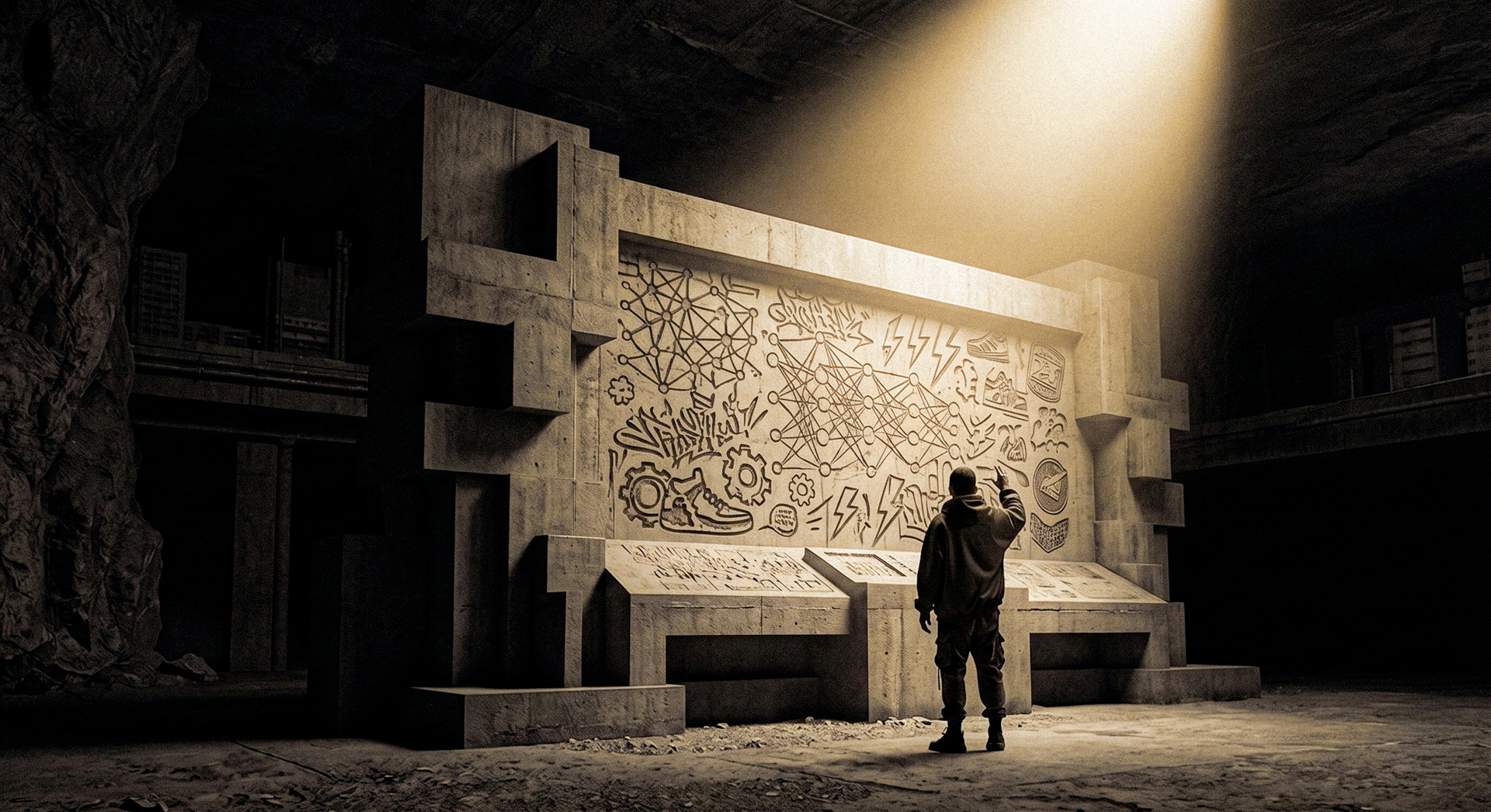
Here's what most analysts get wrong when they study the Supreme story: they conclude that Supreme failed because it scaled. The real lesson is that Supreme failed because it scaled without understanding what it was actually selling.
Not hoodies.
AI companies are currently running identical brand strategy playbooks, often without naming them as such. The mechanism transfers because the psychology is universal. Desire is mimetic regardless of category.
Superhuman: Friction as Positioning
Superhuman launched with 180,000 people on its waitlist and 15,000 paying users. Every new user required a mandatory 30-minute onboarding call. No call, no access. Investors questioned scalability.
The insight that reframes this: the friction wasn't the bug. It was the moat. As Superhuman CEO Rahul Vohra described in public talks, including at a16z Live: frictionless gets you users. Friction gets you believers.
The $30 per month price for an email client was defensible because the product arrived pre-loaded with desire manufactured by everything that preceded access. Over 50% of new users came via referral, despite zero paid acquisition.
And the 'Sent via Superhuman' email signature? That's the Supreme box logo. It makes membership visible to everyone who isn't a member. Visible membership is desire manufacturing at its simplest.
This connects directly to what we’ve written about when examining how Apple created demand for a product nobody knew they needed: the brand doesn’t wait for the market to recognize the value. It manufactures the conditions for recognition first.
It also shares its underlying logic with what we’ve explored in our piece on what drop culture teaches premium brands: a waitlist without community behind it is just a waiting room. The mechanism only works when the people inside it already believe.
Midjourney: Community as Distribution Engine
Midjourney launched in 2021 as a Discord-first product. Early beta access was invite-only. When a subscriber paid, they received five invitations to distribute. The mechanics are structurally identical to the streetwear drop: access is gated, membership signals desire, and the community converts every generated image into shared aspiration.
By the time Midjourney opened publicly in July 2022, demand had been primed by everything the early community had already produced and shared. Zero paid acquisition. No marketing team. No ad budget.
The Product Growth Blog estimated approximately $4.7 million in revenue per employee, compared to Google's $1.8 million and Meta's $1.6 million. The founding team had 11 people. None of them worked in marketing.
The product was the marketing. Every image was a drop.
This is the model that the strongest thinking on demand creation points toward, as we've explored in our piece on why demand follows belief, not awareness: build conviction before you build reach. The waitlist isn't primarily a growth mechanism. It's a positioning instrument.
Scarcity That Sticks vs. Scarcity That Tricks
Most brands that attempt this playbook mistake the tactic for the strategy.
Why Clubhouse Failed the Same Test Supreme Did
Clubhouse's invites were selling for $400 on eBay. Ten million people joined the waitlist. Each user received only two initial invitations. The scarcity mechanics were textbook.
For roughly eight months, Clubhouse was the most desired platform in tech. Then COVID restrictions lifted. Social life resumed. The product couldn't sustain the desire that the scarcity had primed.
The collapse came as fast as the rise.
Scarcity is an amplifier, not a creator. It amplifies desire that already exists because of community membership and genuine product value. Without those foundations, the amplification dissipates at exactly the speed it arrived.
Three Conditions for Scarcity That Sustains
The brands that make this last share three properties.
- The product earns the desire. Scarcity amplifies; it cannot create from nothing. BAPE’s clothes were genuinely different. Superhuman genuinely saved hours. Midjourney’s images were genuinely beautiful. The product has to hold up when the waiting is over.
- The community is real. Gatekeeping without community is just friction. The line outside Supreme was a community. Midjourney’s Discord was a community. Corteiz’s password-protected access is a community. When access becomes identity, it becomes self-reinforcing.
- The scarcity has legible logic. Arbitrary restriction is theater. Meaningful restriction is a rite of passage. The question is whether crossing the threshold means something to the person who crossed it. A 30-minute call that tests readiness. A password that tests cultural proximity. A queue that tests commitment. When the answer is yes, the person who crossed becomes a model. And models manufacture desire.
Frequently Asked Questions
What is drop culture in brand marketing?
Drop culture is the deliberate release of limited quantities of a product at a specific time, with maximum anticipation and minimal advertising. Pioneered by BAPE and Supreme in the 1990s, it has since spread into technology, food, and entertainment. The defining feature is not limited supply but the public visibility of the demand that limited supply generates.
How do AI companies use waitlists as a brand strategy?
The best-performing AI companies treat waitlists as positioning instruments, not demand management tools. Superhuman pre-qualified users through mandatory onboarding. Midjourney built an invite-based community that primed desire before public launch. In both cases, the waitlist made membership visible, manufactured social proof, and delivered users who arrived as believers rather than browsers.
Is scarcity a sustainable brand strategy, or does it always collapse?
Scarcity collapses when it meets a scale mandate without real community underneath it, as seen in Clubhouse and Supreme post-acquisition. When the product earns the desire and the community is genuine, scarcity can sustain for decades. BAPE held the formula for roughly fifteen years. Midjourney appears to be holding it now. The decay condition is consistent: growth pressure loosens supply discipline, and the desire mechanism breaks.
What is the difference between a limited edition release and a scarcity brand strategy?
A limited edition is a periodic supply restriction applied to a product. A scarcity brand strategy is the operating system: it governs when, how, and to whom the brand makes itself available, not occasionally but permanently. Supreme's Thursday drop wasn't a special event. It was the structure. One is occasional. The other is constitutional.
Before You Optimize for Distribution
Nigo didn't have a brand strategy in 1993. He had a budget constraint that forced him to make something genuinely good and then make it hard to get.
The discovery he stumbled into was this: when you restrict access to something genuinely worth wanting, the desire of the few who have it becomes legible to everyone who doesn't. And legible desire is the only advertising that compounds.
Everything that followed was a more deliberate version of the same discovery: the Thursday drop, the International Stüssy Tribe, the password-gated Corteiz site, the Superhuman waitlist, the Midjourney Discord.
The question for any brand in a category where everyone is racing to distribute, to grow, to scale, is not how to be more like Supreme. It's whether you've done the prior work.
Have you built something worth wanting? Have you made the wanting visible? Have you controlled who holds it long enough that desire can propagate?
Scarcity isn't a trick. It's a question the market is forced to answer out loud.
The answer becomes your brand.


Continue
Reading

Best Branding for Startups: Differentiation vs. Distinction
Most branding work for startups delivers a style guide. A style guide governs what a brand looks like. A signal system governs what a brand makes people feel, recall, and associate, at every touchpoint, over time, without being reminded. The difference between the two is the difference between a brand that is different and a brand that is unmistakable.

What Visual Identity Is Actually For (And What AI Cannot Replace)
The designer who cannot articulate the argument behind each element of a mark has not made a design decision. They have made a visual guess. AI generates visual guesses that look like design decisions. The difference is not immediately visible. That is exactly the problem.

Sustainable Packaging Is Brand Identity, Not Just Ethics
The brands that have built durable advantage through sustainable design share almost nothing in common, except this: the packaging choice was an expression of what the brand already believed about itself, not a response to what regulators or critics required.