Scalable Packaging Architecture for Indian Consumer Brands
June 9, 2026





Your first SKU is beautiful.
You spent four months on it. A studio that understood the brief. A soft launch that generated more DMs about the packaging than about the product. You are proud of it, and you should be.
Fast forward fourteen months. You have launched five more SKUs. Each one briefed under pressure, to whoever had availability, at the moment you needed it. Your brand now occupies half a shelf at a modern trade retailer, and it looks like five different companies happened to place their products side by side.
Here is what happened. You made a packaging decision, when you needed to make an architecture decision.
The most expensive mistake in building brand identity for consumer brands in India is not a bad logo or a weak colour palette. It is designing SKU 1 without designing the system that will carry SKUs 2 through 20. One creates a beautiful product. The other creates a brand.
Packaging architecture is the structural logic that determines how a product range is organised and expressed. The aesthetics come after the architecture. The palette, the visual style, the premium finish: these live on the surface. Architecture is what lives underneath.
This is a framework for building that system before you need it.
Contents
1. What Packaging Architecture Is (And What Founders Think It Is)
2. Why Consumer Brands Design SKU 1 in Isolation, and Pay for It at SKU 5
3. The Three-Layer Model: How Scalable Packaging Systems Are Built
4. The Four Load-Bearing Elements of Brand Identity on Pack
5. Designing for SKUs That Do Not Exist Yet: The Range Simulation Method
6. The 5-Pack Test: Stress-Testing Your Brand Identity System
7. Frequently Asked Questions
8. Architecture Is a Decision You Make Once
What Packaging Architecture Is (And What Founders Think It Is)
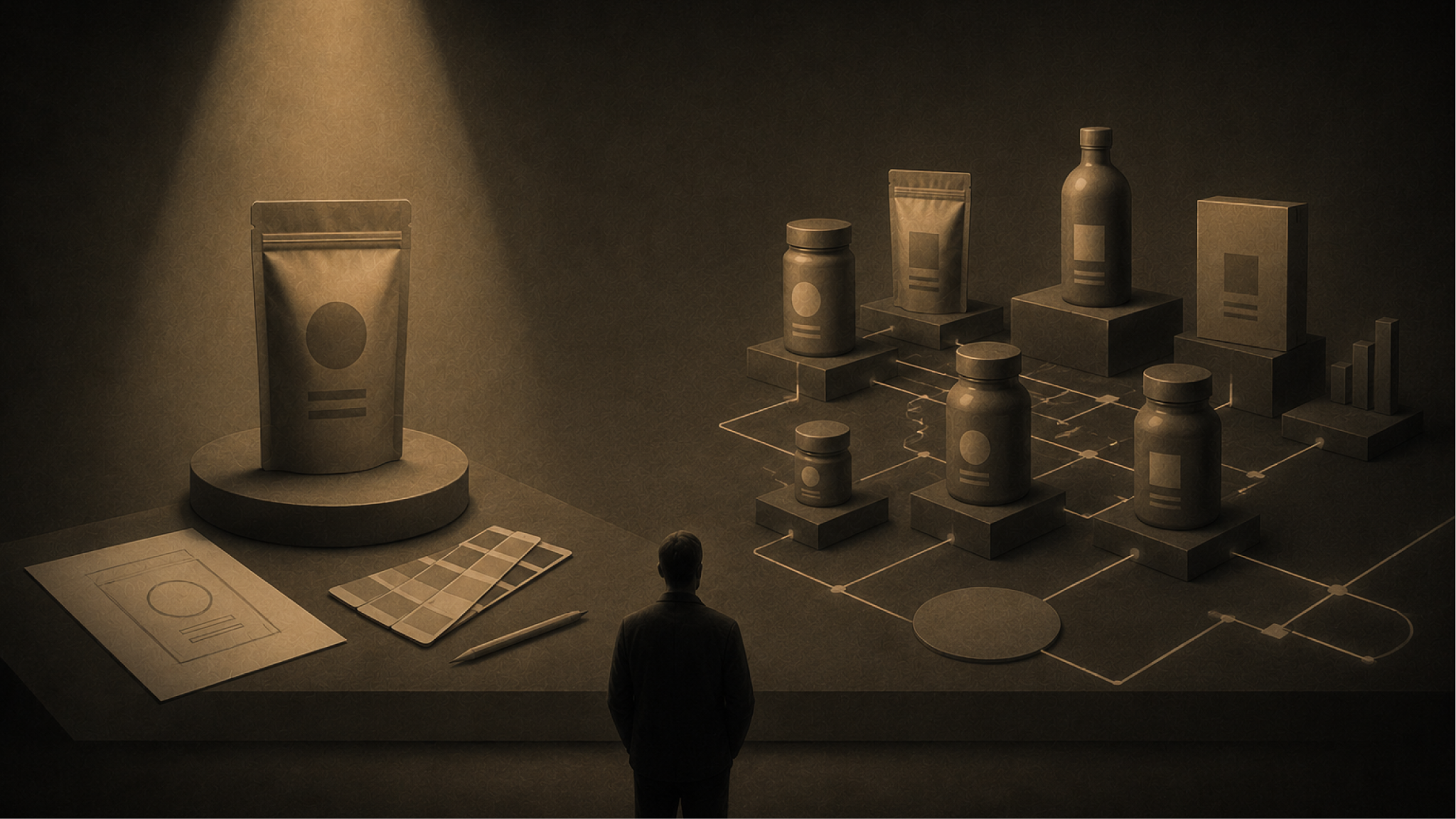
Most founders think packaging architecture is the answer to a design question.
It is not. It is the answer to a systems question.
There is a useful distinction hiding in how founders brief packaging work. They brief it as a design problem: make the packaging look premium, the colour needs to feel natural, can we make it stand out on shelf. These are legitimate inputs. But they are inputs to a surface, not to a structure. The outcome is a beautiful single SKU with no system underneath it.
Architecture vs. Decoration

A designer who makes individual packs look good is doing a different job than a designer who builds a system that scales.
The first produces a beautiful SKU. The second produces a range. Most founders brief for the former and discover, too late and too expensively, that they needed the latter.
The UK packaging agency Greatergood Brands defines retail-ready packaging design as a system that is "consistent enough to block on shelf and build brand recognition, distinctive enough for shoppers to navigate with confidence." Both conditions have to be satisfied. Consistency alone does not produce a range. Distinction alone does not produce a brand. The architecture is what holds both requirements simultaneously across every product you will ever make.
Brand blocking is one of the most commercially undervalued ideas in FMCG. It is the ability of a range to read as a single visual unit on shelf, to own a section of the fixture rather than simply occupy it. You cannot block without architecture. You can have a beautiful product without architecture. You cannot have a brand range. Everything downstream // how packaging performs in 200 milliseconds on shelf, how a range reads as a system rather than a collection // depends on this decision being made first.
The Brief That Creates the Problem
The architecture problem is created before the first design file is opened.
It is created in the brief.
Marty Neumeier named this precisely in The Brand Gap (2003). The gap between business strategy and creative execution is where most brand failures live. Creative decisions made without a systematic brief produce work that looks good but does not compound. Apply that to packaging: a brief that says "make this look premium" will always produce a beautiful single unit. It will never produce a system.
The brief change costs nothing extra to write. It just requires asking a different question. Not "what should this pack look like" but "what should this system do, and how many products does it need to hold?"
Why Consumer Brands Design SKU 1 in Isolation, and Pay for It at SKU 5

There is a structural reason this happens, and it is not laziness.
When founders brief their first product, the future roadmap does not exist yet. They have a single product, a limited budget, and a designer with no visibility of what comes next. Every creative decision at SKU 1 is a reasonable response to the brief as written. It is only at SKU 3, 4, or 5 that the architectural consequences become visible.
What looked like a sensible colour choice becomes a constraint when you need variant differentiation. What felt like a distinctive typographic decision becomes a problem when it will not fit on a smaller format. What started as a bespoke illustration style becomes a financial burden when every new product needs a new bespoke illustration.
This is not a design failure. It is an architectural failure, and the brief produced it.
Innocent Drinks: When Organic Growth Breaks the System
Innocent Drinks, the UK fruit drink brand founded in 1999, made exactly this mistake at scale.
In 2024, Irem Mainwaring, the brand's Head of Brand and Portfolio, said publicly what most founders discover privately: "Our designs have evolved organically as we have grown." The original clarity had been lost. The portfolio had expanded to four product families across 18 markets, and the packaging system that had accumulated over 25 years no longer held together.
The 2024/25 redesign, by the independent agency Derek&Eric with strategist Silas Amos, was not a refresh. It was a reconstruction. The team stripped back the entire visual system and rebuilt it from a single anchor element outward: a unified language of typography, colour, and photography, applied consistently across every product family and every market.
That is the cost of organic growth without architecture. Not a tweak. A full redesign, starting from first principles, across an entire portfolio.
The Indian SKU Escalator: Mamaearth's Coherence Problem
In the Indian D2C context, the same problem compounds faster.
Mamaearth launched in 2016 with six baby care SKUs. By 2021, the brand had scaled to over 140 SKUs across baby care, skincare, and haircare. In FY2023, according to their own IPO filing, they were launching new products at more than 5.7 times the category median rate.
Their green and white palette created strong masterbrand recognition. Shoppers could identify a Mamaearth product from across an aisle. That is brand blocking, and it worked.
But here is what did not work. Confetti Design Studio's packaging audit of the brand identified a recurring problem at the variant level: day cream and night cream were difficult to distinguish because the palette-driven consistency had left no room for variant colour-coding. The brand had solved brand blocking without solving range navigation. High consistency. Low differentiation.
Both are required. Neither alone is architecture.
Brand blocking without navigation produces a range that shoppers can find but cannot read. Navigation without brand blocking produces an incoherent shelf. Packaging architecture is the structural decision that gives you both at once, because each element has been assigned to the right layer.
The Three-Layer Model: How Scalable Packaging Systems Are Built
Every element on a pack lives on exactly one of three structural layers.
This is the most useful way to think about packaging architecture, because it gives you a decision framework for every design choice you will ever make. The question is never "what should this element look like?" The question is "which layer does this element live on, and what are the rules for that layer?"
The three layers are: the masterbrand layer (constant across all SKUs), the range layer (differentiates product families), and the SKU layer (differentiates individual products within a family). Confusion about which layer an element belongs to is the single most common cause of architectural breakdown in Indian consumer brand packaging.
The FMCG packaging consultancy Tapiiri frames it well: think in layers. Masterbrand assets first. Range rules second. SKU signals third. Decide which element carries recognition first, and build the system accordingly.
Layer 1: The Masterbrand Layer (What Never Changes)
The masterbrand layer is the set of elements that appear on every SKU, in every format, in every market.
● Logo placement and scale rules
● Primary typeface or typefaces
● Core brand colours
● Structural shape constants
● Any proprietary mark or icon
These elements exist to build recognition. They are what makes a shopper identify your brand before they have read a single word.
Wally Olins, in On Brand (2003), framed this as the distinction between brand constants and brand expressions. Constants earn recognition before any other signal. Expressions provide variety and depth. The masterbrand layer is all constants. Nothing variable lives here.
Layer 2: The Range Layer (What Changes by Family)
The range layer is the architecture that lets a shopper navigate.
This is the layer most Indian D2C brands under-invest in. They build the masterbrand layer, and then skip directly to individual product decisions. The result is strong brand recognition with no range navigation: a shopper who can identify your brand on a shelf but cannot tell your recovery range from your daily care range without reading every label.
Paper Boat, designed by Elephant Design in Pune, got this right from the beginning. The masterbrand layer carries the childhood nostalgia, the illustration language, the specific typography. Within that, each flavour carries a distinct colour expression. A shopper does not need to read "Aam Panna" to know which product they are reaching for. The colour is doing the navigation work. That is a range layer doing its job.
Layer 2 decisions: colour coding for product families, illustration or photography style per category, secondary typeface applications. These elements can change across families. They cannot change randomly.
Layer 3: The SKU Layer (What Changes by Product)
The SKU layer is the only place where individual product decisions live.
Variant name, hero ingredient or benefit claim, format size, limited edition badge. Everything that makes this product different from the one next to it. This layer is, by design, the most flexible layer. It can change freely. But it can change only within the parameters the architecture defines above it.
The mistake is letting SKU-layer decisions bleed upward: a one-off illustration style added for "personality," a new typeface introduced because this product "feels different," a colour that contradicts the range logic. Each of these collapses the system. Fact and Form's packaging research from December 2025 puts it precisely: "the strongest systems define which elements carry variation and which remain fixed. The variation is systematic, not random."
Systematic variation is the goal. Random variation is what produces the shelf that looks like five different companies.
The Four Load-Bearing Elements of Brand Identity on Pack
Beyond the three-layer model, there are four structural decisions that must be made architecturally at the outset. For the system. If any one of them is decided for SKU 1 alone, the architecture will fail at scale.
This is also where packaging crosses from a brand identity decision into a surface decision // the territory our piece on packaging as a brand surface covers in detail.
1. Visual Zone Architecture (The Grid)
The grid defines where things live on pack and in what proportion.
Brand name zone, variant name zone, imagery zone, legal zone. These rules must be proportional rather than fixed in pixels, so the same grid works on a 10ml sachet and a 500ml jar. Josef Muller-Brockmann established the foundational argument in Grid Systems in Graphic
Design (1968): the grid is the invisible structural logic underneath coherent visual systems. It is what makes visual order feel inevitable rather than imposed.
Applied to packaging: the grid is the portable rule that makes brand blocking possible at any scale and in any format. Breaking the grid should always be a deliberate choice, not an accident of iteration. The handwritten label notes on Innocent Drinks products are a deliberate grid-break, a personality signal the brand owns. An accidental grid-break is simply inconsistency.
2. Typography Hierarchy
The typeface hierarchy must be fixed before SKU 1.
Brand name treatment, variant descriptor, benefit claim, body copy: each level needs a defined size ratio, weight, and spacing rule that holds across all formats. Typography is the element that most visibly collapses under scale pressure. A condensed face that reads beautifully on a wide bottle label becomes illegible on a small sachet.
Anushka Sani, founder of Thought Over Design (the studio behind The Whole Truth Foods' visual identity), articulated why this is a system-level decision: "We wanted to create an identity that conveys factual, truthful information directly and clearly." The decision to layer a handwritten script over the main typeface was not a one-off styling choice. It was a brand-level rule. That rule enabled The Whole Truth to expand from protein bars across chocolates, snacks, and entirely new product categories over three years, without redesigning its packaging architecture once.
A typographic decision made for SKU 1 that does not scale becomes a constraint at SKU 8. Define the hierarchy as a system, not as a response to a single product.
3. Colour Architecture
The most consequential early decision in packaging architecture, and the most commonly mishandled.
The question is not "what colour is the brand?" The question is "what function does colour perform?" There are two architecturally distinct answers, and choosing between them shapes every product you will ever make.
If your masterbrand colour is used as a full-bleed background on SKU 1, you have no colour budget left for range differentiation. The canvas is committed. Every new product family will need a different signal to navigate by, because the one signal that could have carried the most navigational weight has already been consumed by masterbrand application.
If your masterbrand colour is used as an accent or structural element against a neutral base, you retain the range layer for product family coding. The masterbrand is present on every pack. The range layer can still use colour to help shoppers navigate.
Forest Essentials, the Indian luxury Ayurveda brand, uses gold as a structural constant rather than a background: applied to borders, typography treatments, and detail elements. The product and range category inform the imagery and colour of the pack. The masterbrand signal is consistent. The range layer remains flexible. An enormous product range, from lip care to body oils, reads as a single brand without sacrificing navigability.
Compare this to Mamaearth: full-bleed green as the masterbrand signal. Strong blocking. No range layer. The colour architecture decision at SKU 1 created the variant differentiation problem at SKU 80.
4. Format Scalability
Define the full format matrix before designing for any single format.
Most brands are designed for the hero format, the first product they launch, and then stretched to sachets, travel sizes, gift boxes, refill packs, and every other format the brand eventually requires. Stretching is not architecture. It is improvisation.
A structurally sound system defines the proportional rules and hierarchy priorities that allow the same visual language to re-express itself at any scale. The brand's key visual asset, the element that carries recognition first, must still be legible at the smallest format in the range.
As Sprout Studios frames it: structural touchpoints can reinforce brand unity before a consumer reads a single word. The packaging architecture defines which of those touchpoints are non-negotiable across every format, and which can flex at the SKU level.
Designing for SKUs That Do Not Exist Yet: The Range Simulation Method
In almost every packaging brief we receive, the founder has never thought about SKU 6.
Here is the question every Indian consumer brand founder should ask before approving a packaging system.
If a designer joins your team in three years, with no background in your brand, and you hand them your packaging guidelines, can they produce a new SKU that looks like it belongs to the range without you having to correct their work? If the answer is no, the system lives in one designer's taste, not in a document. And a system that lives in one person's taste is not a system. It is a dependency.
The Range Simulation Exercise
Before finalising the SKU 1 design, block out six to eight hypothetical future SKUs using the architecture rules.
Rough structural mockups with placeholder colours, names, and blocked-in imagery zones. Run the architecture against a hypothetical range before it becomes a real one.
If two future variants look identical, the range layer is not doing its work. If the masterbrand element disappears when variant colour is applied at scale, the colour architecture is broken. If the layout collapses at a smaller format, the grid is not portable.
The simulation costs one design day. Correcting the architecture at SKU 5, after products have already shipped, costs a complete redesign and the reputational disruption of a visually incoherent shelf.
The evaluative standard is simple: consistent enough to block on shelf and build brand recognition, distinctive enough for shoppers to navigate with confidence. Both have to pass. Run the simulation until they do.
Writing the Architecture Brief
The brief change costs one paragraph and forces every strategic decision that should precede design anyway.
Most packaging briefs say: "Design packaging for [product name]."
An architecture brief says: "Design a packaging system that begins with [product name], will expand to [X product families] and [Y format types] over [timeframe], and must maintain coherence across [shelf environment, digital channel, gifting context]."
The information required to write that brief forces the founder to think about the range they intend to build before briefing a single SKU. Thought Over Design worked as ongoing design partners with The Whole Truth Foods from the original naming and identity through every new range launch across protein bars, chocolates, and snacks. The architecture brief approach enabled expansion across three years and multiple product categories without a single redesign. That continuity is not luck. It is the outcome of a system built to carry growth rather than contain it.
The simulation is what you run before you commit. The 5-Pack Test is what you run when you want to know if the system is still holding.
The 5-Pack Test: Stress-Testing Your Brand Identity System
This is a diagnostic tool. Five tests, each pass or fail, that can be run in sequence in under two hours with mockups or printed proofs.
Apply it to a proposed system before committing. Apply it to an existing range to understand where the architecture is breaking down. Either way, the results tell you what to fix before a redesign or a new launch.
Test 1: The Brand Block Test
Arrange eight to ten different SKUs side by side on a surface or in a digital mockup. Does the range read as a single brand family? Can a shopper tell, at two metres, that these products belong to the same brand, before reading anything?
If not, the masterbrand layer is broken. Brand blocking is the ability of a range to read as a single visual unit on shelf, to own a section of the fixture rather than simply occupy it. The Brand Block Test is a direct measure of whether your masterbrand layer is doing that work.
Test 2: The Navigation Test
Ask five people unfamiliar with the range to find a specific variant from a lineup of eight to ten SKUs. The night cream. The mango flavour. The sensitive skin formulation.
If they consistently misidentify or take more than five seconds, the range layer is not doing its work. This is a user test, not a design opinion. The range layer exists to make navigation fast and confident. If it does not, the architecture needs attention at the range level.
Test 3: The Thumbnail Test
Reduce all SKUs to 100px wide thumbnails. This is approximately the standard width of a product image on Nykaa, Amazon, or Flipkart category pages. Does the brand name still register? Does each SKU still read as distinctly branded?
For D2C brands in India, the digital shelf is the primary selling environment. A system that holds on a physical shelf but collapses to an indistinguishable colour block on a marketplace category page has a real commercial problem. Design for the thumbnail from the beginning.
The brands that look different every quarter because three different designers touched them, with no system to hold the visual language together: that failure is visible here first.
Test 4: The New Format Test
Take the architecture and apply it to a format that does not exist in the range yet. A sachet. A gift box. A travel-size tube. Does the system hold without reinventing the layout?
If the designer must rethink the structure from scratch at each new format, the grid is not portable. The architecture has stayed in one designer's head, not in a documented system.
Test 5: The Designer Handoff Test
Hand the design files and the architecture guidelines to a new designer. Ask them to produce one new SKU using the system, with no additional briefing beyond what is documented.
If the result looks like it belongs to the range without correction, the architecture is transferable. If it does not, the system exists as one designer's accumulated taste, which means the system does not exist at all.
Cway, which manages design architecture for FMCG brands, sets the standard correctly: "Great FMCG artwork is not created from scratch each time. It is built on a foundation of design architecture, reusable brand elements, layout systems, icons, and proven templates." If your packaging system requires starting from scratch, it fails this test. That is not success deferred. It is absence confirmed.
If you want to go deeper on what specifically fails at shelf before the test can even be run, the piece on the 200-millisecond shelf test covers that ground directly.
Frequently Asked Questions
What is packaging architecture?
Packaging architecture is the structural logic that governs how a product range is organised and expressed visually. It determines which elements remain constant across all SKUs (the masterbrand layer), which differentiate product families (the range layer), and which differentiate individual products (the SKU layer). It is the system before the surface, not the aesthetics of any single pack.
How do I design consistent packaging for multiple products?
Build the three-layer model first: define your masterbrand constants, your range differentiation signals, and your SKU-level variables before briefing any design. Then run the range simulation exercise on hypothetical future SKUs. For consumer brands in India selling across Nykaa, Amazon, or modern trade, design for both the physical shelf and the 100px thumbnail simultaneously. The system has to hold at both scales.
When should a brand create a packaging system, before or after launch?
Before any SKU is designed. The architecture brief should precede the first design file. That said, it is never too late to build one. For brands that have already launched, the range simulation exercise should be run against existing SKUs to identify where the current system is breaking down and where the range layer is absent. Retrofitting architecture is more expensive than building it first.
What happens if a brand redesigns packaging without an architecture?
The most common outcome is a new first SKU that looks great in isolation and still does not solve the range coherence problem. The visual vocabulary changes. The structural problem does not. Innocent Drinks spent 25 years of organic packaging evolution before a full portfolio rebuild became necessary, precisely because individual SKU decisions accumulated into a system without architecture. Redesigning without architecture first produces the same problem, with a different aesthetic on top of it.
Architecture Is a Decision You Make Once
Think of the FMCG ranges that feel inevitable on shelf.
Not the ones you admire because they are beautiful, but the ones where you can feel, without consciously noticing, that every product belongs. The ones where a new variant lands and immediately reads as part of the family. Where you never quite clock that a designer had to make hundreds of decisions to produce that effortlessness.
Every one of those ranges was built by someone who thought about SKU 10 before they released SKU 1.
They did not know what their future products were. They had never seen them. But they built a system that could accommodate them. A set of structural rules that made growth coherent rather than chaotic.
Architecture is not a constraint on creativity. It is the condition that makes creativity compound.
The question is not whether you can afford to build a packaging system. The question is whether you can afford to build a range without one.


Continue
Reading

Best Branding for Startups: Differentiation vs. Distinction
Most branding work for startups delivers a style guide. A style guide governs what a brand looks like. A signal system governs what a brand makes people feel, recall, and associate, at every touchpoint, over time, without being reminded. The difference between the two is the difference between a brand that is different and a brand that is unmistakable.
What Visual Identity Is Actually For (And What AI Cannot Replace)
The designer who cannot articulate the argument behind each element of a mark has not made a design decision. They have made a visual guess. AI generates visual guesses that look like design decisions. The difference is not immediately visible. That is exactly the problem.

Sustainable Packaging Is Brand Identity, Not Just Ethics
The brands that have built durable advantage through sustainable design share almost nothing in common, except this: the packaging choice was an expression of what the brand already believed about itself, not a response to what regulators or critics required.