Provenance as Brand Capital: What Heritage Brands Know That Startups Don't
June 3, 2026
.png)




Seven words.
"You never actually own a Patek Philippe. You merely look after it for the next generation."
Read it again. Not as advertising copy. As philosophy.
That sentence, which has appeared on Patek Philippe dials and in their campaigns since the late 1990s, does something most brand communication fails to do. It does not describe a product. It describes a relationship between the owner, the object, and time itself. It reframes ownership as stewardship. It inserts the buyer into a lineage that existed before them and will continue after them.
This is what a boutique branding agency that works at the level of structure, and not surface, is always trying to understand: where does that kind of authority come from, and can it be built?
The common answer is that it comes from age. From decades, from centuries, from the slow accumulation of reputation. The assumption is that provenance is something only old brands can have, and that new brands should reach for shortcuts: heritage-inspired design, archival palettes, serif fonts that whisper "established."
That assumption is wrong. And it is costing young brands something they cannot buy back.
In This Article
- Provenance Is Not History: It’s Accumulated Authority
- Walter Benjamin and the Boutique Branding Agency’s Aura Problem
- Why Time Cannot Be Purchased: Three Things Startups Get Wrong
- The Three Pillars of Architected Provenance
- Two Young Brands That Got It Right
- Frequently Asked Questions
Provenance Is Not History: It's Accumulated Authority

There is a distinction that most branding conversations fail to make.
Age is not provenance. Provenance is not heritage. Heritage marketing is what a brand does when it wants to signal provenance without necessarily having earned it. Provenance is the thing itself: the actual chain of documented decisions, materials, craftspeople, and contexts that give an object its weight.
Hermes was founded in 1837 as a harness workshop. That founding fact is interesting. What is extraordinary is what happened next: the brand kept the saddle workshop. Not because it was commercially essential. The leather goods business has long since eclipsed anything equestrian in Hermes's revenue. The saddle workshop exists because its existence does something nothing else can: it makes the leather goods mean something different. Every Birkin carries, in its stitching and its price and its waitlist, the ghost of a craft that predates the automobile.
The workshop is operational provenance.
Provenance is not what you say about your past. It is what your present decisions say about who you intend to be.
The Difference Between Age and Authority
The Stern family has owned Patek Philippe since 1932. During the quartz crisis of the 1970s, when Swiss watchmaking was being hollowed out by cheap, accurate Japanese movements, Patek Philippe refused to adopt quartz. The decision cost revenue. It cost market share. It cost the brand the accessibility that might have broadened its customer base.
It also built one of the most durable luxury mythologies in the world.
A brand that drifts, that is acquired and repositioned, that sheds its founding constraints in the name of growth, may retain its age. It will lose its provenance. The Stern family's refusal is a provenance decision: a documented moment where the brand chose consistency of intent over short-term accommodation. That choice, held across decades, is what makes the tagline credible. The seven words work because they are backed by over a century of choices made in that spirit.
Authority, unlike age, has to be maintained.
Provenance as Barthesian Myth
Roland Barthes, in the theoretical appendix to "Mythologies" (1957), describes how objects move between orders of meaning. At the first order, a Patek Philippe is a timekeeping device. It measures hours and minutes. It is, mechanically, an object.
At the second order, Barthes would call it a myth. The watch has become generational stewardship. Swiss precision. The refusal of compromise. The myth naturalises the premium: the price stops feeling like a price and starts feeling like a consequence. The consumer does not feel they are paying more for a watch. They feel they are entering a lineage.
This is the mechanism provenance activates. It moves the product from sign to myth, from purchase to inheritance. And once the myth is intact, the brand is insulated from the competitive pressures that price-sensitive categories face. You do not comparison-shop your way into a Patek Philippe.
Walter Benjamin and the Boutique Branding Agency's Aura Problem
In 1935, Walter Benjamin wrote an essay that was not about branding at all, and accidentally described the central challenge of modern brand-building.
"The Work of Art in the Age of Mechanical Reproduction" argues that original artworks possess aura, which Benjamin defines as "a unique phenomenon of a distance however close it may be." Aura derives from the artwork's rootedness in a specific time, place, and set of hands. A reproduction lacks it, because the reproduction lacks that origin.
"The authenticity of a thing," Benjamin writes, "is the quintessence of all that is transmissible in it from its origin on, ranging from its physical duration to the historical testimony relating to it."
Apply this to brand.
Heritage brands have brand aura because they are genuinely present in history. Their objects carry the historical testimony of the decisions that produced them. The problem facing every new brand, and the central challenge for any boutique branding agency working with them, is Benjamin's core warning: reproduction destroys aura. You can reference heritage through visual language. You cannot manufacture it.
The Reproduction Trap: When New Brands Perform Heritage

There is a recognisable failure mode here.
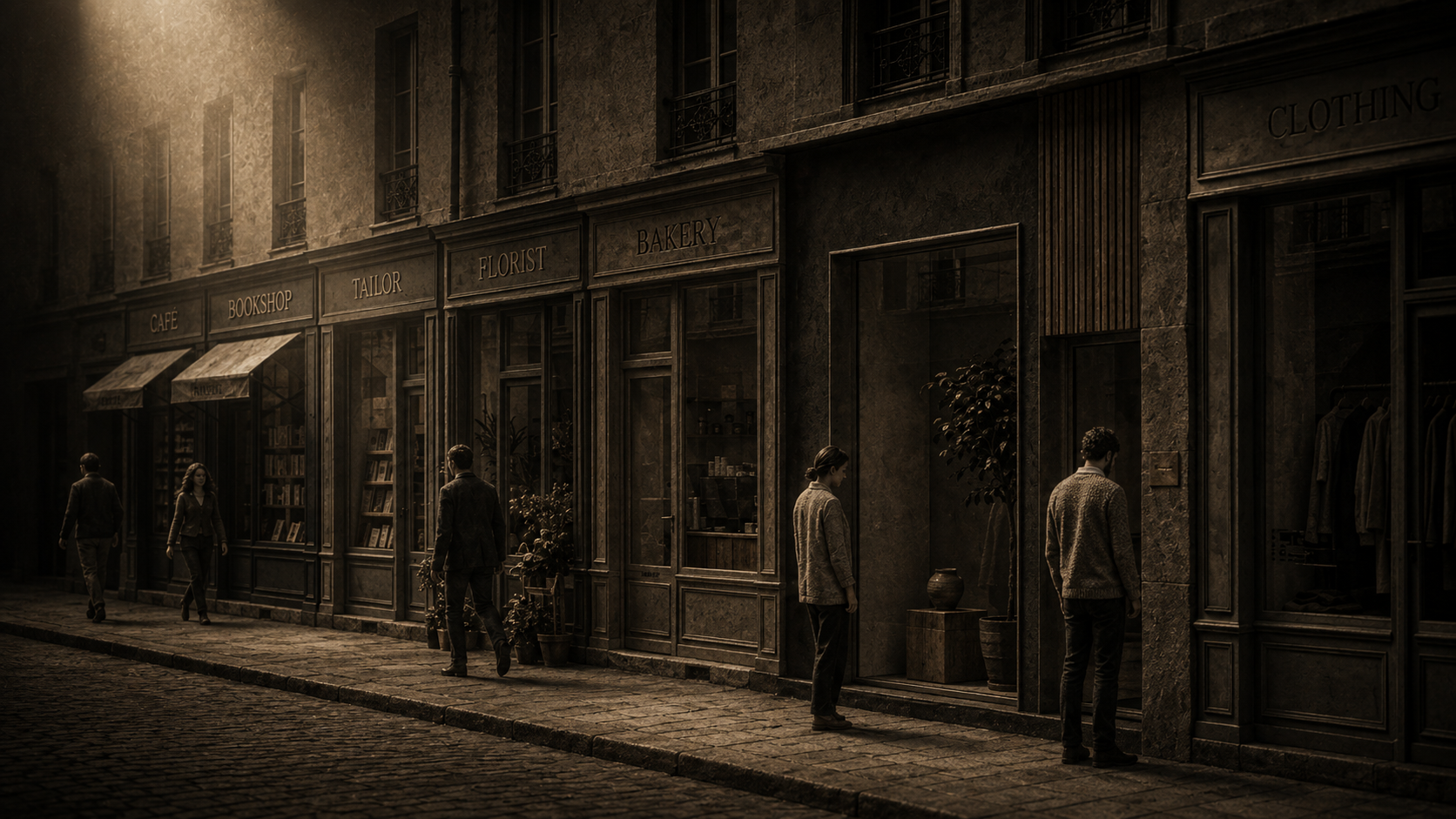
The brand launches with a monogram, though the founders started the company last year. The packaging is kraft and understated. The copy uses words like "craft" and "generations." The product photography is archival, slightly desaturated, shot on film or made to look like it was.
Each of these signals, in isolation, might be defensible. Together, they constitute what Benjamin would recognise as reproduction: the visual language of provenance deployed without its substance. Increasingly literate brand consumers detect the performance.
Contrast this with the Louis Vuitton monogram canvas. Georges Vuitton introduced it in 1896, one year after his father Louis's death, in direct response to a specific problem: counterfeiting. The monogram has a documented origin. It has a documented reason. Every bag that carries it is traceable, in a visible and verifiable sense, to that 1896 decision. The aesthetic is inseparable from the fact.
The LV monogram is not heritage signalling. It is heritage.
Performed Heritage vs. Structural Provenance
The Aura of Process: Why Craft Visibility Changes Everything

Here is the counterpoint, and the turn.
Aura can be built forward. It does not only flow backward from history.
The mechanism is process visibility, understood as an ontological claim rather than a marketing tactic. When a brand makes the act of making visible, it roots the object in specific labour, specific time, specific hands. This is exactly what gives a thing aura in Benjamin's framework: the historical testimony of its origin. A new brand that documents its production from the beginning is writing the first entries in its archive.
Everlane launched in 2010 with factory photography and detailed cost breakdowns as its primary brand content, before it spent significantly on advertising. The factory photographs were not supplementary. They were foundational. Every image of a specific factory, a specific worker, a specific margin structure, was the brand's earliest provenance claim: this is where these things come from, and we can prove it.
Patagonia's Footprint Chronicles went further. The initiative allowed consumers to trace individual products back through the supply chain, linking each garment to its factory and its environmental footprint. The programme predated most competitors by nearly a decade.
That duration is itself a provenance claim.
Why Time Cannot Be Purchased: Three Things Startups Get Wrong
There are three specific failure modes. Each has a fix.
- Mistaking aesthetics for architecture
- Skipping the founding document
- Launching without ritual
Mistaking Aesthetics for Architecture
Heritage visual signals are decoration without a structural story beneath them. The serif, the kraft packaging, the archival colour palette: these operate, in Barthes's framework, at the level of denotation. Without the connotation (the brand story) and the myth (the provenance architecture) doing their work beneath them, they carry nothing to a second order.
Aesthetics without architecture is costume.
A boutique branding agency builds the load-bearing walls first, then chooses the finish. Reverse this order and the brand reads as performance. Because it is.
Skipping the Founding Document
Every brand that has lasted has a founding document. The critical thing to understand is what that document actually does.
Emily Weiss launched Into the Gloss in 2010, four years before Glossier existed. Her 2014 launch post, which opened Glossier's commercial life, read: "Glossier begins with YOU." A decade later, that line is still cited in brand analyses. It has not drifted. The brand has stayed legible against that original declaration.
That accountability is what makes a founding document valuable. Its accountability, not its sentiment. Not its elegance. The sentence must be specific enough that you cannot quietly walk it back without everyone noticing.
Yvon Chouinard's "Let My People Go Surfing," published in 2005, operationalised Patagonia's founding philosophy into a set of constraints: no Black Friday advertising, 1% for the Planet, repair rather than replace. Every subsequent brand decision is either consistent with that text or visibly at odds with it. The book functions as a public standard against which the brand is permanently measured.
A founding document is not a values statement. It is a constraint you are willing to be held to.
This is closely connected to how brand voice takes shape over time — the founding document sets the frequency that all future communication tunes to (more on this in our piece on why luxury brands speak slowly).
Launching Without Ritual
Ritual is the vehicle through which provenance accumulates in real time.
James Jebbia opened Supreme in 1994. The Thursday product drop was not designed as a brand strategy. It emerged from skateboarding culture's rhythm: the Thursday allowance cycle through which young skaters received their weekly spending money. Jebbia kept it. That act of keeping, of deliberately maintaining a pattern that had emerged organically, is what transformed logistics into mythology.
Victor Turner's work on ritual liminality, developed in "The Ritual Process" (1969), describes how ritual creates a threshold state that transforms participants. The Supreme drop became exactly this: a weekly event with predictable timing, controlled scarcity, and a community of participants who understood the stakes. Over years, the ritual accumulated its own history.
Ritual creates the temporal texture of a brand. Over years, recurrence becomes its own form of history.
The Three Pillars of Architected Provenance: What to Build From Day One
A boutique branding agency working with a new brand has three things to build from the start. These are not nice-to-haves. They are the infrastructure on which everything else rests.
Pillar One: The Origin Document
Not an About page. Not a values statement.
A founding document is a statement of intent so specific that it names what the brand refuses, as clearly as it names what the brand makes. It must be constraining enough to be uncomfortable. Patagonia's Chouinard did not write a philosophy book, though the result became one. He wrote a set of constraints that made every subsequent decision legible. The brand's refusal to run Black Friday advertising, more than a decade before that position became fashionable, was only possible because the constraints had been written down and made public.
The Patek Philippe tagline functions as an analogous founding constraint. Seven words that make every subsequent product decision, every pricing decision, every distribution decision, legible against a single standard. Does this decision honour the standard? If it does, proceed. If it does not, reconsider.
A document that has been kept is proof of consistency over time. That proof is the first unit of provenance a new brand can generate.
The myth that builds around a founder — how it is told, how it is kept honest — is a related question we explore in our piece on the mythology of the founder.
Pillar Two: Process Transparency as Craft Proxy
Showing process is an ontological claim.
Everlane's factory photographs were the earliest entries in the brand's archive. Patagonia's Footprint Chronicles created a traceable history of production decisions that preceded most competitors by years. Neither initiative was primarily about ethics signalling. They were about rootedness: the claim that these objects come from specific places, made by specific people, at specific cost.
A new brand that begins documenting its production from day one is writing the first chapters of a history that will compound over time. In ten years, that archive is provenance. More on this in our piece on brand ritual and experience design, which covers how documentation becomes experience over time.
Pillar Three: Manufactured Ritual
Ritual does not have to be complex to work. It has to be consistent.
A weekly newsletter published on the same morning. A product drop on the same day each season. An annual gesture that becomes expected. The content of the ritual matters less than its regularity, because regularity is what creates temporal texture. The sense that something happens at this brand, reliably and recurrently, is the precondition for any deeper feeling of meaning.
Erving Goffman's argument in "The Presentation of Self in Everyday Life" (1959) is that repeated performance consolidates identity. What a person is seen to do, consistently, becomes what that person is. The same principle holds for brands. Supreme's Thursday drop is what Supreme is, as much as any product it has ever released.
Two Young Brands That Architected Provenance Deliberately
Glossier: The Community That Preceded the Product
By the time Glossier launched its first product in 2014, Into the Gloss had between two and three million monthly unique visitors. Four years of documented conversation about beauty, about what customers wanted, about what the market was failing to provide. By launch day, the brand already had a verified history of intent. The provenance was the conversation, and the conversation was real.
This is provenance architecture at its most rigorous. Glossier did not invent a heritage. It substantiated one. The founding document, "Glossier begins with YOU," was credible on the day it was written because it was backed by four years of evidence. The brand's origin story was not a story about the founder. It was a story about the community, and the community was there to confirm it.
Research by Lundqvist et al., published in the Journal of Brand Management (2013), confirms that firm-originated brand stories have a measurable effect on brand experience and associations. The mechanism is exactly what Glossier exploited: the origin story changes how every subsequent interaction is perceived.
Supreme: When Ritual Becomes Mythology
James Jebbia opened Supreme because there were no decent skate shops in New York at the time. That is the origin story. It is radically unromantic, and that is why it works as provenance.
What Jebbia built over the following three decades was a machine for accumulating ritual. The Thursday drop, maintained from the beginning. The store layout, deliberately intimidating, essentially unchanged in character across relocations. The box logo, itself a citation of Barbara Kruger's confrontational art practice, giving the mark an art-historical anchor that most brand logos do not possess.
The Barbara Kruger connection matters more than it usually gets credit for. Jebbia did not design a logo. He referenced one. The Supreme box logo points back to a specific artist, a specific body of work, a specific commentary on consumer culture. It carries, in its geometry, an argument about the world. That is architected provenance: a mark whose meaning is traceable to a documented source.
Supreme's myth was built through duration, consistency, and a refusal to accommodate itself to the mainstream. The lesson cuts both ways: Supreme eventually sold to VF Corporation, and the myth began, predictably, to erode. Provenance architecture requires maintenance. You cannot build it once and leave it.
Frequently Asked Questions
What does a boutique branding agency do that a larger agency doesn't?
A boutique branding agency works closer to founding intent. Without the process dilution of large teams and long timelines, it can do the structural work: writing origin documents, designing ritual infrastructure, making process transparency a brand asset from the start. Provenance work belongs in the branding brief, not the marketing brief.
How do new brands build equity without a long history?
Through deliberate provenance architecture. Origin documents, visible craft process, and designed ritual are all available on day one. History is one path to provenance. Consistency of intent, documented from the beginning and maintained against pressure, is another. The brands that build this infrastructure early are the ones with something real to show in ten years.
What is the difference between brand heritage and brand provenance?
Heritage is backward-looking: it deploys the past as a signal. Provenance is the substance that makes heritage legible, the documented chain of decisions, materials, and intent that gives the heritage signal something to stand on. Heritage can be performed. Provenance cannot be faked without the performance eventually becoming visible.
Can a startup have provenance?
Yes. A startup that writes a constraining founding document, makes its production process visible and documented, and builds a recurring ritual from the beginning is generating provenance in real time. What takes heritage brands decades to accumulate accidentally, a deliberate startup can begin building on day one. The infrastructure is available. Most brands choose not to build it.
Provenance Is Always a Choice
Return to the dial.
"You never actually own a Patek Philippe. You merely look after it for the next generation."
That sentence does not work because the brand has existed since 1839. Many brands have existed longer and say nothing worth remembering. It works because every decision the brand has made since 1839: the refusal of quartz, the family ownership maintained through acquisition pressure, the saddle workshop kept open, the complications hand-finished by craftspeople who trained under craftspeople who trained under craftspeople, has been made as if someone were watching.
Provenance is not what accumulates when you are old.
It is what accumulates when you decide, from the beginning, to be the kind of brand that can afford to be patient.
The best time to start was the day you launched. The second best time is now.


Continue
Reading

Best Branding for Startups: Differentiation vs. Distinction
Most branding work for startups delivers a style guide. A style guide governs what a brand looks like. A signal system governs what a brand makes people feel, recall, and associate, at every touchpoint, over time, without being reminded. The difference between the two is the difference between a brand that is different and a brand that is unmistakable.
What Visual Identity Is Actually For (And What AI Cannot Replace)
The designer who cannot articulate the argument behind each element of a mark has not made a design decision. They have made a visual guess. AI generates visual guesses that look like design decisions. The difference is not immediately visible. That is exactly the problem.

Sustainable Packaging Is Brand Identity, Not Just Ethics
The brands that have built durable advantage through sustainable design share almost nothing in common, except this: the packaging choice was an expression of what the brand already believed about itself, not a response to what regulators or critics required.